
Cradle to Cradle: the certification that promotes sustainable products
Cradle to Cradle certification is an international ecolabel that evaluates products according to the principles of the circular economy. It aims to ensure that each product has a limited environmental impact throughout its life cycle. This label primarily aims to reduce waste and promote […]

Article summary
- Cradle to Cradle Certification in a Nutshell
- What is Cradle to Cradle?
- What are the two cycles of Cradle to Cradle?
- What is the difference between Cradle to Grave and Cradle to Cradle?
- What are the 5 criteria to meet to be Cradle to Cradle certified?
- What are the 4 levels of C2C certification?
- What are the advantages of Cradle to Cradle?
- What steps need to be taken to obtain Cradle to Cradle certification?
- Step 1 – Check product eligibility
- Step 2 – Select an independent assessment body
- Step 3 – Collect important data
- Step 4 – Evaluation and official report
- Step 5 – Sending the official request
- Step 6 – Certification and valuation
- Step 7 – Renewal of certification
- FAQ
- What does the Cradle to Cradle label guarantee?
- What is the cost of Cradle to Cradle certification?
- Who is the certifying body for Cradle to Cradle?
- How does the Cradle to Cradle label differ from other environmental certifications?
Cradle to Cradle certification is an international ecolabel that assesses products according to the principles of the circular economy. It aims to ensure that each product has a limited environmental impact throughout its life cycle. This label mainly aims to reduce waste and promote the reuse of materials in industrial sectors.
The Cradle to Cradle label allows companies to demonstrate their commitment to environmental responsibility. Access to the label, award criteria, benefits for labeled companies, ETERNITY Systems explains everything you need to know about Cradle to Cradle.
- Cradle to Cradle Certification in a Nutshell
- What is Cradle to Cradle?
- What are the 5 criteria to meet to be Cradle to Cradle certified?
- What are the 4 levels of Cradle to Cradle certification?
- What are the advantages of Cradle to Cradle?
- What steps need to be taken to obtain Cradle to Cradle certification?
- FAQ
Cradle to Cradle Certification in a Nutshell
- Cradle to Cradle, or C2C, is an international certification in four levels which evaluates products according to the principles of the circular economy, with as final objective of eliminating the notion of waste.
- The label is based on two complementary cycles : the biological cycle, which allows organic materials to return to nature, and the technical cycle, which ensures the infinite reuse of industrial materials.
- Certification is awarded based on five criteria : material health, circularity, carbon footprint, water and soil management, and social equity.
- The benefits are multiple for businesses : reduction of environmental impact, enhancement of brand image, competitive advantage, and concrete contribution to a circular economy.
What is Cradle to Cradle?
Cradle to Cradle, in French "from the cradle to the cradle", is a concept created in 2002 by Michael Braungart and William McDonough, according to which every product must be designed to have several livesIt aims for complete circularity, where each product is designed from the outset to be reused, recycled or transformed without losing quality..
Unlike traditional recycling, the goal of Cradle to Cradle is no longer just to limit the environmental impact, but to make it positive. by transforming waste into resources and integrating eco-design practicesIt is the philosophy of 0 pollution, 100% reuse.
This certification, managed by the Cradle to Cradle Products Innovation Institute since 2010, imposes a logic circular economy which commits companies to:
- Use materials that are safe for health and the environment.
- Reduce greenhouse gas emissions.
- Design products so that each element can be disassembled, recycled or reused.
These Cradle to Cradle principles resonate with future European requirements of the Packaging and Packaging Waste Regulation, which aim to regulate the design and end of life of packaging on the EU internal market.
Thus, each stage of the life cycle becomes an opportunity to create value rather than a source of pollution. This logic is in line with the objectives of the AGEC law in France, which encourages companies to strengthen reuse and to better manage their packaging with a view to a circular economy.
What are the two Cradle to Cradle cycles?
Cradle to Cradle takes into account two aspects to assess whether a product is designed with circularity and respect for the environment in mind: the biological cycle and the technical cycle.
- Le biological cycle concerns organic materials, such as food waste or plant residues. They are designed to be reintroduced naturally into the environment, for example through composting.
- Le technical cycle applies to non-organic materials, such as metals or plastics. These elements are designed to be reused endlessly in the manufacture of new products, ensuring continuous circularity of resources.
What is the difference between Cradle to Grave and Cradle to Cradle?
Le Cradle to Grave follows a linear model that leads products to become waste, without consideration for the environment and without a vision of reuse, while the Cradle to Cradle establishes a circular cycle where each resource is reused.
- The Cradle to Grave model ("from cradle to grave") corresponds to the classic pattern of the linear economy: extract, produce, consume then throw away. This operation depletes natural resources and generates waste with no real prospect of reuse.
- Cradle to Cradle ("from cradle to cradle"), on the other hand, is based on a circular logic where each product is designed to be recycled, regenerated or transformed indefinitely. Waste becomes raw materials, while materials remain reusable. The ultimate goal is sustainable production, without pollution and without loss of value.

What are the 5 criteria to meet to be Cradle to Cradle certified?
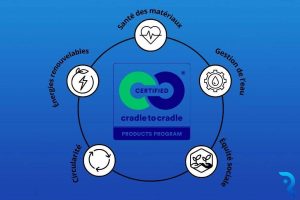
The “Cradle to Cradle Certified®” label is awarded to products based on 5 criteria: material health, product circularity, use of renewable energy and carbon management, responsible water and soil management, and social equity.
- Materials health : it is about eliminating toxic substances and favoring components that are safe for human health and the environment.
- Product circularity : it involves designing each element of a product so that it can be disassembled, reused or recycled in new production cycles.
- Renewable energy and carbon : it is about reducing greenhouse gas emissions by promoting the use of clean energy and low-carbon production.
- Water and soil management : this involves ensuring responsible use of water resources and limiting pollutant discharges in order to preserve ecosystems.
- Social equity : it is about respecting human rights, ensuring safe and fair working conditions, and contributing positively to local communities.
What are the 4 levels of C2C certification?
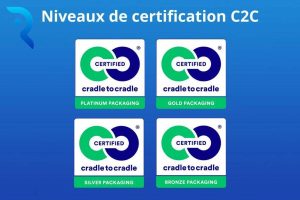
The Cradle to Cradle certification level has 4 certification levels Bronze, Silver, Gold, and Platinum – awarded to encourage companies to move towards excellence in sustainability.
Each product is evaluated according to the five C2C criteria, and a score is assigned for each criterion, determining the overall level reached to move towards an optimal version of the product.
- Bronze : This is the first level of compliance. The most hazardous substances are eliminated, energy and water consumption is measured, and a basic social action plan is put in place to initiate the process. For example, a paint manufacturer eliminates toxic pigments and sets up a monitoring system for its consumption.
- Silver : this second level reflects progress towards better practices. The materials used are safer, a significant proportion of renewable energy is integrated into production, and an external social audit verifies compliance with commitments. For example, a textile brand introduces certified organic cotton and partially powers its production with solar energy.
- Gold : This third level marks the achievement of high standards. Materials are largely safe and recyclable, production relies primarily on renewable energy, water is treated to reduce pollutant discharges, and the supply chain adheres to stricter social standards. For example, one food packaging manufacturer uses only recyclable plastic and powers its factories with 80% renewable energy.
- Platinum : this level of excellence represents the ultimate goal. All materials are non-toxic and designed to be circular, production runs exclusively on renewable (or fully offset) energy, wastewater is purified to drinking quality, and social compliance is guaranteed by an independent monitoring body. For example, a furniture company makes its products from wood from sustainably managed forests, operates exclusively on wind power, and guarantees complete social traceability throughout its supply chain.
What are the benefits of Cradle to Cradle?
There are several benefits for a company to be Cradle to Cradle certified:
- Respect for the environment and human health : the products are designed without toxic substances (non-toxicity), which reduces risks for users and ecosystems.
- Improved brand image : certification enhances the company's standing with customers and partners by demonstrating a concrete commitment to sustainability.
- Commitment across the entire production chain : each stage, from design to end of life, is redesigned to limit impacts and promote circularity.
- Commitment beyond traditional recycling : products are designed to be reused indefinitely, not simply to limit waste.
- Competitive advantage : being Cradle to Cradle certified differentiates the company in its market and can strengthen its attractiveness in the face of competition.
- Reuse of raw materials : components are integrated into new production cycles, reducing dependence on virgin resources.
There is nevertheless some limitations to Cradle to Cradle, related to costs and feasibility for certain products. Indeed, compliance with certification often requires higher costs, as materials and manufacturing processes must be adapted. On the other hand, some products that are too complex, made of glued or inseparably assembled materials, cannot be reintroduced into a circular cycle, and are therefore not eligible for certification.
What steps should be taken to obtain the Cradle to Cradle label?
Obtaining certification Cradle to Cradle Certified® is based on a process that takes place in 7 stages:
- Check product eligibility,
- Choose an independent assessment body,
- Collect important data,
- Evaluation and writing of a report,
- Submit the official request,
- Receive certification and promote it,
- Renew certification.
Step 1 – Check product eligibility
The first step is to analyze the composition of the productIt must be free from prohibited substances (toxic or dangerous) and incorporate, from the design stage, a continuous improvement process. This verification ensures that the product can truly enter into a circular logic.
Step 2 – Select an independent assessment body
The Cradle to Cradle Institute provides a official list of approved organizations who become the main intermediary who will guide the evaluation of the productThe company must choose one of them, define a certification plan, anticipate the costs, the schedule, and the necessary resources.
Step 3 – Collect important data
With the organization's support, the company gathers all information on materials, the manufacturing process, and the supply chain. This collection is crucial because it allows to verify traceability and measure the environmental and social performance of the productSite visits are also organized to monitor compliance on the ground.
Step 4 – Evaluation and official report
The assessment body analyzes the collected data according to C2C standards and prepares a detailed report. This report summarizes the results, compliance points, and areas for improvement. The report is then sent to the Institute, which makes the final decision.
Step 5 – Sending the official request
The complete file is sent to the Cradle to Cradle Products Innovation Institute accompanied by application fees and annual certification fees. These costs cover administrative management and official recognition of the product.
Step 6 – Certification and valuation
Once validated, the company obtains the Cradle to Cradle Certified® label at the corresponding level (Bronze, Silver, Gold or Platinum). This certification becomes a tool that can be integrated into marketing communications, sales materials, and policy CSR to promote the approach to customers and partners.
Step 7 – Renewal of certification
The Cradle to Cradle Certified® label has a validity period of 2 yearsSix months before its expiration, the company must prepare a new dossier with the assessment body, demonstrate its progress in circularity and pay the renewal fee. This step ensures continuous improvement and avoids any loss of certification.
Cradle to Cradle illustrates a new way of designing products, where each resource retains its value and is integrated into a reuse cycle. This certification provides concrete answers to current challenges: waste reduction, resource preservation and alignment with growing expectations in terms of sustainability.
In this same logic of circular economy, ETERNITY Systems develops solutions that promote the reuse of packaging and waste reductionA complementary approach which is part of the desire to support companies towards sustainable and responsible development practices.
FAQ
What does the Cradle to Cradle label guarantee?
The Cradle to Cradle label ensures that a product is designed according to the principles of the circular economy:
- Materials safe for health and the environment,
- Ability to be recycled or reused,
- Use of renewable energies,
- Responsible water management,
- Compliance with social criteria.
How much does Cradle to Cradle certification cost?
The registration cost is around €3.000 to €3.500, varying depending on the type of product and the size of the company. In addition, there are the fees of the independent evaluation body and the renewal fee every two years which amounts to approximately 1750 euros.
Who is the Cradle to Cradle certification body?
C2C certification is issued by the Cradle to Cradle Products Innovation Institute (C2CPII), an independent non-profit organization based in the United States. Assessments are conducted by accredited third-party organizations that collect data, verify compliance, and submit a comprehensive report to the Institute.
How does the Cradle to Cradle label differ from other environmental certifications?
Cradle to Cradle is a product certificationrecognized as type I according to ISO 14024. This means that it is based on an external and independent audit, unlike other company-centric approaches (such as ISO 14001) or on a simple environmental declaration (type III – EPD). Its distinctive feature is also to assign a performance level (Bronze, Silver, Gold, Platinum) which reflects the degree of commitment to the circular economy.

Anthony ADAM
Communications and Marketing Manager at ETERNITY Systems, Anthony designs strategies and content to promote more sustainable consumption. He is a committed agent of change who combines creativity, rigor, and action to strengthen the visibility and impact of projects related to reuse and the circular economy.
These articles might also interest you

GHG Protocol: How to calculate and manage GHG emissions?
CSRD Directive: Definition, challenges and current status 2025
A project to reuse packaging?
Our teams support you from diagnosis to industrial washing, in Europe and North America.
Contact us