The circular economy: how is this model virtuous for businesses?
The circular economy is an economic model that differs from the linear economy by limiting resource waste and promoting reuse. Its objective is to provide concrete sustainable development solutions, such as eco-design, reuse, and waste reduction, in the face of natural resource depletion […]

Article summary
- The circular economy in brief
- What is the circular economy?
- What are the 7 pillars of the circular economy?
- Sustainable supply of resources
- Eco-responsible design
- Industrial and territorial ecology
- The functional economy
- Responsible consumption
- The extension of the duration of use
- Recycling
- What are the advantages of a circular economy for businesses?
- ETERNITY Systems – An example of a circular economy that works
- What are the levers for moving from a linear economy to a circular economy?
The circular economy is an economic model that differs from the linear economy in limiting the waste of resources and promoting their reuseIts objective is to provide concrete sustainable development solutions such as eco-design, reuse and waste reduction, in the face of the depletion of natural resources and increasing pollution.
For French companies, the circular economy is a virtuous model that allows them to reduce supply costs, optimize waste management, and improve their image. How does this model work? What actions should you implement in your company to reduce your environmental impact? ETERNITY Systems explains everything about the circular economy, its advantages and the levers to put in place to initiate a transition.
The circular economy in brief
The circular economy is an economic model introduced as a national objective by the 2015 Energy Transition for Green Growth Act, aiming to reduce the consumption of raw materials and limit waste through reuse and recycling. It is structured around several pillars of action, including eco-design, industrial ecology, the functional economy and responsible consumption.
For companies, the circular economy offers many advantages, not only allowing them to meet growing consumer expectations and regulatory requirements, but also to optimize their costs by reducing their consumption of resources. In addition, by adopting this model, they strengthen their image, and actively contribute to the preservation of the environment.
ETERNITY Systems is at the heart of the challenges of the circular economy, offering a service of industrial washing sustainable and responsible reusable packaging. Our commitment to reuse, traceability and logistics optimization allows your business to begin its transition towards a viable and beneficial circular economy, for an ever greener future.
What is the circular economy?
The circular economy is an economic model consisting of produce and consume goods and services sustainably in order to extend their life cycleAccording to ADEME (the Agency for Ecological Transition), it “designates a set of practices whose purpose is to preserve natural resources such as water, air, soil and raw materials”.
Thus, the circular economy aims to limit the consumption and waste of natural resources and the production of waste by prioritizing reuse, repair, recycling and waste reduction. It therefore exists in opposition to the so-called linear economy which consists of extracting, producing, consuming, and throwing away.
The AGEC law (Anti-Waste for a Circular Economy) of 2020 was introduced with this objective of energy and ecological transition and has had a significant impact on the circular economy, in particular imposing new obligations for sorting and recovering waste and encouraging companies to rethink the design of their products to extend their lifespan.

What are the 7 pillars of the circular economy?
The circular economy revolves around 7 pillars divided into 3 areas of action (production, consumption and waste management), which aim to reduce waste and optimize the use of resources:
- Sustainable sourcing,
- Ecodesign,
- Industrial ecology,
- The functional economy,
- Responsible consumption,
- The extension of the duration of use,
- Recycling.
Sustainable supply of resources
This pillar of the circular economy consists of favoring the use of renewable or recycled resources by selecting raw materials that preserve our environment and long-term natural resources. The objective is to limit the environmental impact from the beginning of a product's life cycle. by opting for traceable and responsible supply chains.
It is in this logic thatETERNITY Systems is committed to reducing water and energy consumption with un efficient washing process, allowing the reuse of +70% of the water consumed. On the other hand, our MT&You solution, which allows packaging to be traced throughout the value chain, ensures optimal monitoring of resource usage.
Eco-responsible design
Eco-design consists of integrate environmental criteria from the creation of a product or a service in order to limit its impact throughout its life cycle.
Industrial and territorial ecology
This principle of circular economy is based on the cooperation between companies located in the same geographical area to optimize the use of resources. For example, the waste of one company can become the raw materials of another. This helps to promote collaboration between local stakeholders to reduce their environmental footprint.
The functional economy
Prioritizing use over possession is based on the idea that the user can benefit from a product or service via rental, subscription or service provision solutions. This model encourages product sustainability, because it is the company that becomes responsible for their proper functioning.
Responsible consumption
Responsible consumption aims to encourage consumers to make choices that favor products or services:
- Durable and high quality, with resistant materials, designed to last over time;
- Repairable and reusable, facilitating their maintenance and repair;
- Recyclable, i.e. designed to be reintegrated into the production cycle once their use has ended.
With this in mind, it is important to raise consumer awareness to help them understand the impact of their consumption choices.
The extension of the duration of use
Extending the life of products relies on their repair, their reuse and their re-useThese 3 Rs aim to reduce the production of new goods while limiting the exploitation of resources and the production of waste.
This pillar is part of the objectives of the AGEC anti-waste law, which aims in part to combat planned obsolescence, a practice consisting of designing products with an intentionally limited lifespan.
Recycling
Recycling is a fundamental pillar of the circular economy, which consists of reintroducing materials from waste into the production cycle. To be effective, recycling must be based on optimized collection through the selective sorting system, efficient material processing and a redesigned production cycle by designing easily recyclable products.
This pillar thus encourages manufacturers to rethink the design of goods to facilitate their recycling and to favor supply chains integrating more recycled materials.
What are the benefits of a circular economy for businesses?
Businesses have everything to gain by adopting a circular economy modelA virtuous model, it not only allows them to reduce their consumption of resources, optimize their costs and limit their greenhouse gas emissions, but also to improve their image and strengthen their commitment to social responsibility:
- Reduction of resource consumption : one of the key principles of the circular economy is the reuse and recovery of existing resources. With this logic, companies can reduce their dependence on raw materials and limit losses, thanks to efficient production systems (eco-design, optimized waste management).
- Optimization of operating costs : the circular economy allows us to reduce many costs: energy costs, those related to waste to be treated, as well as those related to the purchase of raw materials. For example, this involves the use of recycled materials, such as the reuse of packaging, rather than the systematic purchase of new containers.
- Environmental protection: The circular economy not only reduces the need to produce new goods through reuse, but also reduces the transport of long and polluting raw materials, helping to reduce greenhouse gas emissions.
- Improving CSR : the circular economy can be a very good lever to strengthen the social responsibility of a company. Indeed, by reducing waste and optimizing resource management, companies adopt an ethical approach that meets the growing expectations of consumers in environmental matters. On the other hand, on the social level, the circular economy promotes the creation of local and non-relocatable jobs, particularly in the sectors of reuse, recycling and repair.
ETERNITY Systems – An example of a circular economy that works
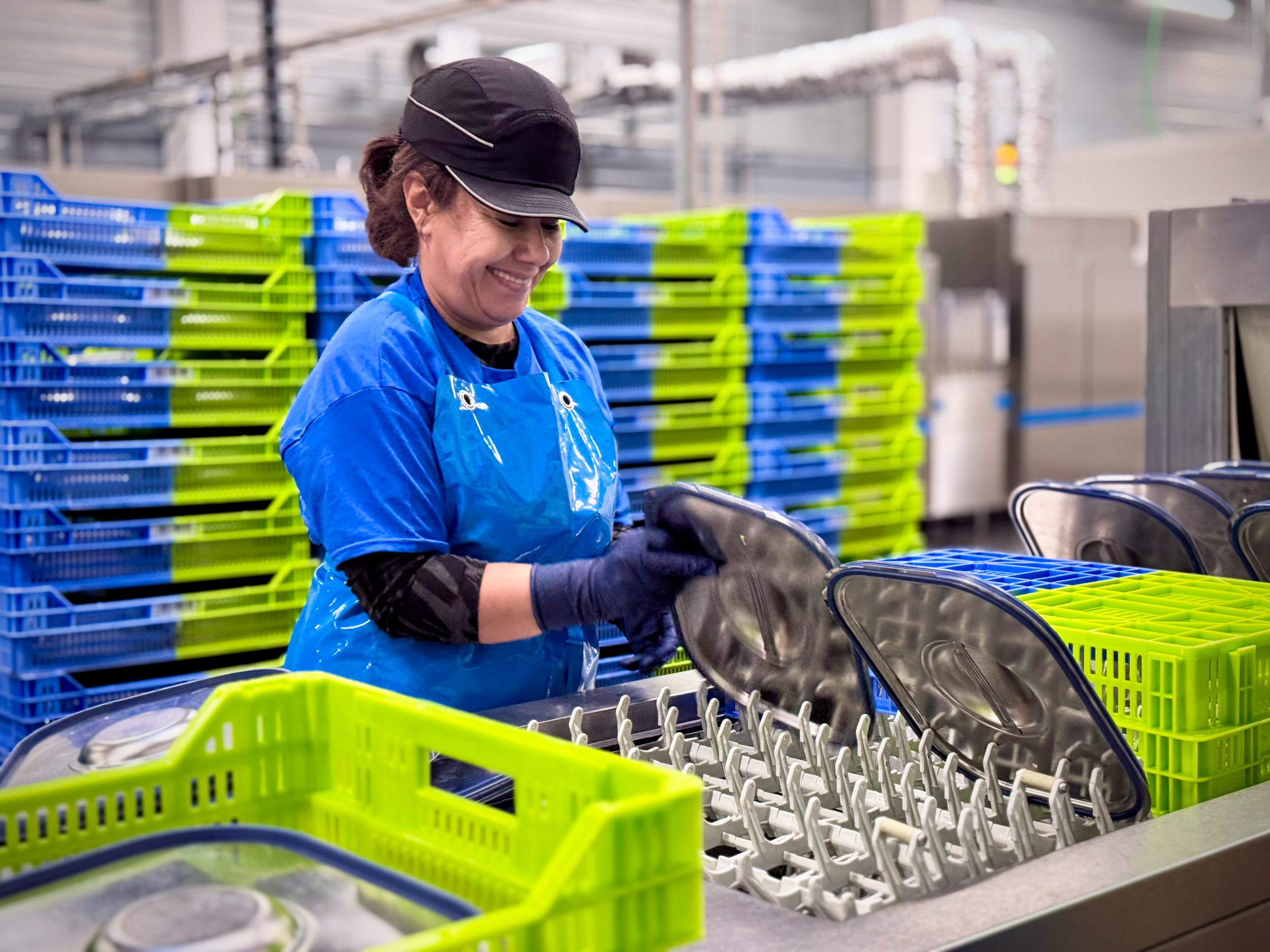
ETERNITY Systems perfectly illustrates what a functional circular economy model looks like through our activity focused on the washing and reuse of packaging. Our company is distinguished by our ability to integrate sustainable practices throughout its activity with:
- An industrial washing system allowing to significantly extend the life of reusable containers (crates, bins, pallets, etc.), helping to reduce waste production while limiting the extraction of new raw materials;
- Ecodesign, at the heart of our processes, by developing resource-efficient washing systems (1L of washing water can be reused up to 300 times);
- A turnkey digital solution to ensure complete traceability of processed packaging. Thanks to a centralized ERP, our customers can track flows in real time and associated invoicing;
- An MT Logistics service which optimizes logistics and transport flows, promoting the reduction of the carbon footprint and the promotion of reuse.
- An activity of packaging repair reusable plastic allowing their life cycle to be extended and their premature disposal to be avoided.
By combining reuse, eco-design, traceability and logistics optimization, ETERNITY Systems demonstrates that it is possible to have a viable and sustainable circular economy model. And thanks to our industrial washing solutions, we effectively support companies in their transition to a more sustainable and responsible economic system.
What are the levers for moving from a linear economy to a circular economy?
To successfully transition to a circular economy, several initiatives have been implemented at national and European levels. These different regulatory levers encourage businesses and consumers to adopt more sustainable practices.
In France, the AGEC law, adopted in 2020 and inspired by the circular economy roadmap published in 2018, imposes concrete objectives such as: reduction in the use of single-use plastics, the obligation to recycle 100% of plastics by 2025, the reduction of waste sent to landfill by 50% and the fight against planned obsolescence via a new repairability index.
In February 2021, the European Parliament adopted a resolution aimed at achieving, by 2050, a carbon-neutral, environmentally sustainable, toxic-free, and fully circular economy, with reinforced actions such as the promotion of sustainable products and consumer responsibility.
In March 2022, the European Commission presented a first set of measures to accelerate the transition to a circular economy, including in particular the boosting sustainable products, the consumer empowerment and a strategy on sustainable textiles. In November 2022, it proposed to new european rules on packaging aimed at improving their design, facilitating recycling and encouraging the use of bio-sourced and compostable plastics.
All of these levers aim to restructure industrial and consumer practices by promoting the reduction of waste at source, the reuse of products and more responsible management of resources, within an increasingly demanding regulatory framework.
Now you know everything about the circular economy and the benefits it brings for a more sustainable future.Adopting this model within your company and your production logic is essential, allowing you to reduce your environmental impact and comply with an ever stricter regulatory framework.
And to initiate a transition towards a sustainable and responsible circular economy, trust in ETERNITY Systems.
If you would like to implement the reuse of your packaging and contribute to a more circular economy, download our white paper by clicking on the button below:

Anthony ADAM
Communications and Marketing Manager at ETERNITY Systems, Anthony designs strategies and content to promote more sustainable consumption. He is a committed agent of change who combines creativity, rigor, and action to strengthen the visibility and impact of projects related to reuse and the circular economy.
These articles might also interest you
Supermarket packaging: how does reuse work?
Sustainable packaging: the complete guide

A project to reuse packaging?
Our teams support you from diagnosis to industrial washing, in Europe and North America.
Contact us