
EGALIM Collective Catering Law: issues, application and new developments
The EGALIM law, which came into effect in 2018, aims to promote healthy, sustainable, and equitable food, particularly in institutional catering. The law sets clear objectives regarding sustainable food, plastic reduction, and the fight against food waste by requiring stakeholders in the sector […]

Article summary
- The EGALIM law in summary
- What is the EGALIM law for collective catering?
- Who is the agriculture and food law for collective catering aimed at?
- What are the 5 measures of the EGALIM law for collective catering?
- Sourcing sustainable and quality products
- Diversification of protein sources and vegetarian menus
- Ban on single-use plastics
- The fight against food waste and food donations
- User information
- How to achieve the objectives of the EGALIM law for collective catering?
- Lotting: a strategic tool for quality
- Train teams and build lasting partnerships
- How does ETERNITY Systems Does it help you meet the objectives of the EGALIM law?
- Ma Cantine Platform: an essential tool for the EGALIM law for collective catering
- The EGALIM law for collective catering in 2025: Assessment and outlook
The EGALIM law, which came into effect in 2018, aims to promote healthy, sustainable, and equitable food, particularly in the catering sector. The law sets clear objectives around sustainable food, reducing plastic, and combating waste by requiring public and private sector stakeholders to transition to more virtuous practices.
For local authorities, this means rethinking procurement, service delivery, and waste management. How can the EGIM law be effectively implemented without increasing the constraints on collective catering? Definition, challenges, implementation, ETERNITY Systems explains everything you need to know for more responsible collective catering.

The EGALIM law in summary
- The EGALIM law was adopted in 2018 following the General Food Conference, aimed at improving food, protecting the environment and supporting producers.
- It applies to all collective catering structures (schools, hospitals, nursing homes, businesses, administrations, etc.) serving more than 200 meals per day.
- For collective catering, at least 50% of the products served must be sustainable or labeled, including 20% from organic farming (with a higher threshold for meat/fish since 2024).
- A weekly vegetarian menu is mandatory in school canteens, in order to diversify protein intake and reduce environmental impact.
- The gradual ban on single-use plastics requires all establishments to switch to reusable containers by 2025.
- The fight against food waste is becoming an obligation, with diagnosis, concrete measures, and recovery of surpluses through donations.
- Users must be informed in a clear and legible manner about the origin and quality of the products served, including vegetarian options and sustainable commitments.
- Lotting is recommended to structure calls for tender by product type and favor local or specialized suppliers.
- The Ma Cantine platform helps establishments monitor their EGALIM compliance through self-diagnostic tools, practical resources and a remote reporting system.
- Partners like ETERNITY Systems, with washing and logistics solutions for reusable containers (via the Re-uz for Eternity alliance), facilitate the transition to sustainable and legally compliant collective catering.
What is the EGALIM law for collective catering?
The EGALIM law for “The Balance of Commercial Relations in the Agricultural and Food Sector and Healthy, Sustainable and Accessible Food for All”, is a French law adopted on October 30, 2018 following the General Food Conference (EGA) organized in 2017 by the government.
The EGALIM law was created to address several issues:
- The precariousness of agricultural income : many French farmers do not make a decent living from their work.
- Food quality : consumers expect more transparency, sustainability and proximity in their food.
- The environmental impact of the food system : food waste, use of single-use plastics, dependence on imported products, etc.
The EGALIM law for collective catering then sets objectives around a societal and environmental pillar which consists of:
- Improving the diet of the French
- Fight against waste
- Reduce the use of plastic
- Promoting sustainable practices in public canteens.
Who is the agriculture and food law for collective catering aimed at?
The law applies to all public or private collective catering structures serving more than 200 meals per day:
- School canteens and catering,
- healthcare establishments (hospitals, nursing homes, clinics),
- company restaurants,
- social and medico-social establishments (reception centers),
- public administrations (communities, ministries, penitentiary establishments)
Catering managers have a legal obligation to comply with the law's objectives, particularly in terms of percentages of sustainable products, vegetarian options, and the gradual elimination of plastic. In the event of non-compliance, sanctions may be imposed, and audits may be conducted to verify compliance.
What are the 5 measures of the EGALIM law for collective catering?
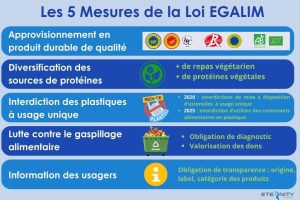
The EGALIM law is based on five major axes that contribute to changing food practices towards greater sustainability, responsibility, and transparency. These measures concern both:
- Supplies
- Service practices
- User awareness
- Waste Management
Sourcing sustainable and quality products
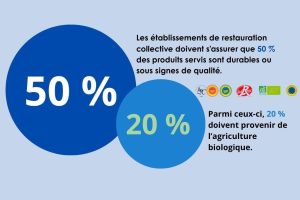
Since January 1, 2022, catering establishments subject to the EGALIM law must ensure that at least 50% of the products served are sustainable or carry quality labels. Of these, 20% must come from organic farming. The following are considered quality products:
- Products under official quality and origin labels (SIQO): for example, foods with labels such as Label Rouge, AOP, AOC, IGP
- Products with the sustainable fishing ecolabel
- Organic and fair trade products
- Products with the RUP logo, which aims to promote products from the outermost regions of the European Union
In 2024, this requirement has been further strengthened, particularly in the meat and fish sector, where 60% of purchases must now be sustainable products.
In this context, buyers in the catering sector are at the heart of the process of rethinking their selection criteria and favoring local producers and establishing fairer relationships with suppliers. A national guide was designed to offer concrete ideas in terms of purchasing strategy and techniques.
Diversification of protein sources and vegetarian menus
As part of the food transition, the EGALIM law also requires the introduction of a vegetarian menu at least once a week in school canteens. This measure meets several objectives:
- Reduce overconsumption of meat
- Limiting the environmental impact of animal production
- Promote a more varied diet.
Beyond a simple meat-free dish, the vegetarian menu must be nutritionally balanced by integrating alternative sources of protein such as legumes, eggs, whole grains or even dairy products.
3 billion meals are served per year in collective catering in more than 80 restaurants. And according to an INRAE survey on legumes conducted in 2019 among chefs and managers of collective catering, 87% want a greater diversity of legumes which are very good vegetable proteins.
This development therefore requires catering teams to adapt their recipes and cooking techniques and to train their staff in new dietary balances.
Ban on single-use plastics
According to the European Parliament, the volume of plastic packaging waste generated per capita increased by around 29% (+8,1 kilos per person) between 2010 and 2021.
And it is in this context that one of the essential measures of the EGALIM law for collective catering concerns the gradual elimination of plastic in catering services:
- Since 2020, the use of plastic food containers has been banned for preparing, heating, and serving meals for children under 6 years old. And from January 1, 2025, this ban will extend to all mass catering establishments.
- Since 2021, the ban on the provision of single-use plastic utensils, whether for payment or free of charge.
- Since 2022, collective catering has been required to use reusable containers for home delivery services.
- From the 1er January 2025, reusable containers or those made from recyclable materials will be required for takeaway sales.
This structural change requires the adoption of reusable containers, such as stainless steel bins or reusable jars. But it also means implementing reliable collection, washing, and traceability solutions. This is where specialized service providers such as ETERNITY Systems, capable of guaranteeing a industrial washing of reusable containers conforms to strictest hygiene standards.
The fight against food waste and food donations
According to ADEME, the consumption phase alone, food waste represents 30 kg per year per person in their household.
Faced with this major challenge, the EGALIM law now requires collective catering establishments to carry out a precise diagnosis and take concrete actions to reduce waste. They must:
- Measure the quantities thrown away,
- Educate guests about the right portion
- Implement suitable solutions to limit losses, such as recycling leftovers into other preparations
The EGALIM law strongly encourages the recovery of food surpluses through donations, particularly to recognized associations such as the Restos du Cœur and the Red Cross. This dynamic requires rigorous organization:
- Identify products that are still consumable but not served
- Store products temporarily in good conditions
- Organize their removal within timeframes compatible with health safety.
- Team training
User information
The EGALIM law imposes a duty of transparency on diners. Users must be informed in a visible and legible manner about the quality of the products served: their origin, label, category (sustainable, organic, local, etc.). This information also concerns vegetarian options, the establishment's commitments to combating waste, and waste management.
This educational approach aims to develop a more conscious and responsible diet. It also encourages establishments to adopt clear, structured communication that is accessible to all audiences, including younger people and people with disabilities.
How to achieve the objectives of the EGALIM law for collective catering?
To effectively implement the requirements of the EGALIM law, collective catering establishments must not only:
- Adapt their purchasing practices
- Adapt their internal organization and their monitoring tools
- Adapt their relationships with suppliers.
Allotment: a strategic tool for quality
Allotment involves dividing a public market into separate lots, usually by product type (fruit and vegetables, meat, dairy, bread, etc.). This method allows for the use of smaller, more specialized suppliers, such as local producers or artisans.
By reducing barriers to entry for small agricultural or craft businesses, allotment promotes diversity of supplies, product quality and the development of local sectors.
Train teams and build lasting partnerships
It is essential that collective catering staff (cooks, managers, service agents) understand the issues of the EGALIM law in order to be able to adapt their practices:
- Developing balanced vegetarian menus
- Integrate new labeled products into recipes
- Manage reusable containers
The success of the regulatory transition for mass catering also requires regular dialogue with suppliers, whether industrial or locally sourced. Establishments can clarify their expectations: desired product types (labels, origin, weights), delivery conditions, supply frequency, but also requirements related to the EGALIM law, such as the absence of single-use plastic in packaging.
It is in this logic thatETERNITY Systems intervenes as a partner by supporting communities in the implementation of reusable containers for collective catering. ETERNITY allows catering companies to comply with the ban on single-use plastic, while maintaining smooth and secure logistics.
How does ETERNITY Systems helps you meet the objectives of the EGALIM law?
Among the major challenges posed by the EGALIM law is the gradual ban on single-use plastics in collective catering, with a deadline set for all establishments of 2025. This measure notably involves replacing disposable tableware with sustainable containers, while ensuring strict hygiene conditions with controlled logistics and good traceability.
It is on these issues that intervenes ETERNITY Systems, as a partner of collective catering establishments by offering, in partnership with Re-uz, complete support, from the provision of reusable containers to the logistics flow management through industrial washing.

Ma Cantine Platform: an essential tool for the EGALIM law for collective catering
To support establishments in the practical implementation of the EGALIM law, the Ministry of Agriculture has launched the Ma Cantine platform, a free digital tool, specially designed to support those involved in collective catering.
My Canteen offers:
- Educational resources such as practical guides, memo sheets and even vegetarian menu recipe advice
- A self-diagnostic tool that allows establishments to assess their level of compliance with the EGALIM law: organic rate, frequency of vegetarian menus, use of plastic, etc. This helps identify priority actions to be taken.
- An indicator tracking system to monitor purchasing data via a remote reporting system
It is therefore a platform that makes it possible to make the efforts made visible, to identify the levers that can still be activated, and to mobilize teams around common and measurable objectives.
The EGALIM law for collective catering in 2025: Assessment and prospects
Halfway through its implementation, the EGALIM 2 law, supplemented by the Climate and Resilience law, shows mixed results in the collective catering sector. Indeed, the quantified objectives set by the law have not yet been fully achieved. The main difficulties concern:
- Compliance with the threshold of 20% of organic products, particularly in rural areas or areas with a low production base;
- The ban on single-use plastic containers, which requires significant logistical investments to move to reuse ;
- The complexity of public procurement, which hinders access to calls for tender for small local producers, despite incentives for allocation.
Despite these obstacles, the outlook for 2025 also shows an acceleration of efforts:
- The development of team skills, particularly through training, pooling between communities and tools such as the Ma Cantine platform;
- The rise of reuse, with solutions like those proposed by ETERNITY Systems and its partnership with Re-uz, which provides a concrete response to the ban on plastic in restaurants
- The development of new local sectors, in conjunction with agricultural cooperatives and regional purchasing groups.
Companies like ETERNITY Systems are part of this dynamic, by offering operational solutions that allow canteens and collective restaurants to effectively meet regulatory requirements while modernizing their operations.

Anthony ADAM
Communications and Marketing Manager at ETERNITY Systems, Anthony designs strategies and content to promote more sustainable consumption. He is a committed agent of change who combines creativity, rigor, and action to strengthen the visibility and impact of projects related to reuse and the circular economy.
These articles might also interest you

Supermarket packaging: how does reuse work?

Sustainable packaging: the complete guide


A project to reuse packaging?
Our teams support you from diagnosis to industrial washing, in Europe and North America.
Contact us