
PPWR: Everything you need to know about packaging management in Europe in 2026
The Packaging and Packaging Waste Regulation (PPWR), which entered into force on August 12, 2026, completely redefines the European framework surrounding packaging and packaging waste, and marks a major step forward for industry and the entire European internal market. Since its entry into force, all companies in each Member State […]


Article summary
- The European PPWR regulation in summary
- What is PPWR?
- What are the main objectives of the PPWR Regulations?
- Who is affected by PPWR and packaging management?
- What are the new PPWR obligations applicable from August 12, 2026?
- 1) Limitations on PFAS in food contact packaging
- 2) The PPWR Declaration of Conformity
- 3) Identification and registration of REP
- Schedule and details of upcoming applicable PPWR measures
- 2027 and 2028: technical details and labeling
- 2029: Deposit and collection
- 2030 – Obligations for eco-design, recyclability and reuse
- 2035 and 2038 – stricter requirements
- 2040 – the final stage
- How does the PPWR relate to French regulations?
- What are the penalties for failure to comply with PPWR obligations?
- PPWR Compliance Checklist
- PPWR FAQ
- What is the PPWR declaration and what should it contain?
- Where can I find the official text of the PPWR?
- Does the PPWR apply to SMEs and micro-enterprises?
- What is the difference between the PPWR and the AGEC law?
Effective August 12, 2026 the PPWR regulations (Packaging and Packaging Waste Regulation) completely redefines the European framework around packaging and packaging waste, and marks a major step forward for the industry and the entire European internal market.
Since its entry into force, all companies in each Member State must comply with stricter requirements for waste reduction, reuse and traceability. ETERNITY Systems helps you understand the concrete impacts of the PPWR, what is required today and the measures to anticipate.
The European PPWR regulation in summary
- The PPWR (EU 2025/40) is a European Union regulation on packaging and packaging waste. which applies from 12 August 2026 in all Member States, without national transposition.
- The objectives of the PPWR These include waste reduction, improved recyclability, the development of reuse and the harmonization of rules throughout the EU.
- It concerns all companies that place packaging on the European market, regardless of their size and sector. from manufacturers to importers, distributors, e-commerce businesses and logistics providers.
- Three obligations have already been due since August 2026. the limits of substances including PFAS, the conformity assessment with its EU declaration, and registration in the national register of producers.
- The upcoming deadlines for PPWR concern labelling in 2028, deposit in 2029, then recyclability, recycled content and reuse on January 1, 2030.
- Each Member State shall determine its sanctions regime by 12 February 2027 at the latest. with mandatory administrative fines for breaches of articles 24 to 29.
What is PPWR?
The PPWR (Packaging and Packaging Waste Regulation) which means in French "Regulation on packaging and packaging waste" ", is a European text that aims to harmonize packaging requirements Member States, manufacturers and distributors in the EU. As it is a regulation, the PPWR applies uniformly in all Member States, without the need for national transposition.
It replaces European Directive 94/62/EC and is part of the European Green Deal strategy. The PPWR regulation aims to all types of packaging : food, industrial, e-commerce, logistics, etc.
What are the main objectives of the PPWR Regulations?
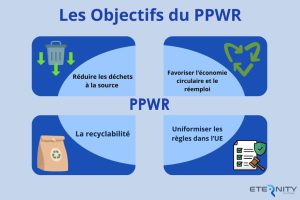
The PPWR regulation sets specific and measurable targets to transform the way packaging is designed, used and treated across all EU Member States:
- Reducing packaging waste at the source The primary objective of the PPWR is to reduce the amount of packaging placed on the market by limiting over-packaging, non-recyclable formats, and single-use packaging without justification
- Recyclable packaging requirement From 2030 onwards, all packaging placed on the market must be recyclable, according to specific technical criteria. The PPWR introduces a system of recyclability classification (from A to E), where only packaging rated at least "C" will be allowed. This requirement aims to ensure their compatibility with existing sorting and recycling infrastructure.
- Promote eco-design and reuse The PPWR aims to impose a circular approach to packagingat all stages of the life cycle. This means keeping materials in the economic cycle for as long as possible, while reducing dependence on virgin materials.
- Standardization of rules at European level Today, packaging regulations vary from country to country. The PPWR aims to create a common framework with complete harmonization of national legislation in order to facilitate trade, reduce regulatory barriers, and strengthen the competitiveness of European sectors.
The PPWR standard impacts many sectors: manufacturers, importers, distributors, e-commerce businesses or logistics providers, who must comply.
Who is affected by PPWR and packaging management?
The PPWR applies to all companies that place packaging on the market in Europe. regardless of their sector or sizeIt concerns both:
- Local producers
- The distributors
- Importers
- End users, within a framework of extended producer responsibility (EPR).
The sectors most impacted by the PPWR standard are e-commerce, retailRestaurants and takeaway businesses will have to adapt their packaging, offer reusable containers, or implement deposit systems. Importers must also comply with these rules for packaging coming from abroad.
Beyond manufacturers, the entire supply chain is affected by PPWR. The regulation mandates new packaging management practices. sorting, washing and traceability. To support this transition, our solutions ETERNITY Systems become essential to guarantee large-scale reuse objectives.
Test: Am I affected by the PPWR regulations?
What are the new PPWR obligations applicable from August 12, 2026?
Three categories of bonds have already been due since August 12, 2026:
- Limits on substances in packaging
- Proof of conformity and
- Identifying the producers.
The following deadlines will apply automatically on their respective dates to all companies placing packaging on the European market in the 27 Member States. This is because, unlike a directive, a regulation applies directly in all 27 Member States, without the need for national legislation to transpose it.
1) Limitations on PFAS in food contact packaging
From 2026 onwards, the regulation sets caps to limit PFASThese fluorinated compounds, used to make packaging waterproof and greaseproof, are nicknamed "eternal pollutants" because they hardly degrade and are harmful:
- 25 ppb for a substance measured in isolation, or 25 grams in 1,000 tonnes of material
- 250 ppb for the sum of the PFAS
- 50 ppm of all PFAS combined, including polymers.
Source: Regulation (EU) 2025/40, Article 5, paragraph 5
2) The PPWR Declaration of Conformity
Since August 12, 2026, no packaging can be placed on the market without having undergone a conformity assessment.The company must compile technical documentation in accordance with Annex VII and establish a EU declaration of conformity for each type of packaging. This is the document that customers often request under the name PPWR attestation or certificate.
Sources: Regulation (EU) 2025/40, Article 15(2) (manufacturers' obligations), Article 38 (conformity assessment procedure), Article 39 (EU declaration of conformity) and Annex VII (technical documentation))
3) Identification and registration of REP
Since August 12, 2026, every package must allow tracing back to its owner. Three actors are involved:
- The manufacturer must be identifiable on the packaging
- The importer and the distributor must verify what they put into circulation
- The producer must register in the national register of producers in each Member State where it places packaged products on the market.
Sources: Regulation (EU) 2025/40, Article 15, paragraph 6 (identification of the manufacturer), Articles 18 and 19 (obligations of importers and distributors), Article 44 (register of producers)
Packaging placed on the market before August 12, 2026 can continue to be sold and does not have to be withdrawn.
Schedule and details of upcoming applicable PPWR measures
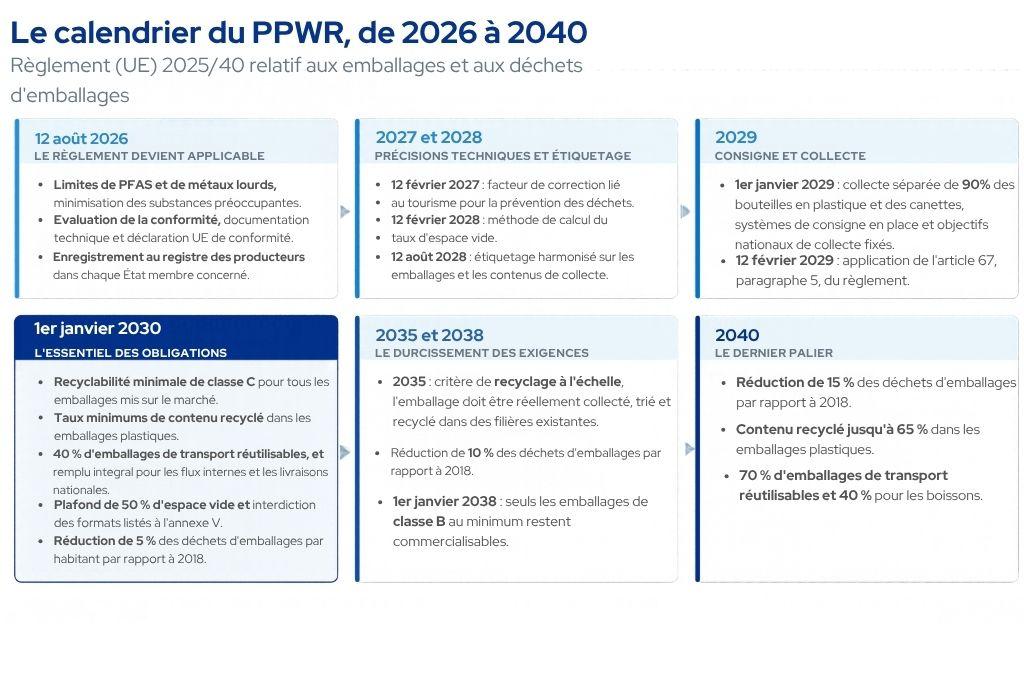
After August 12, 2026, the PPWR measures are structured around four deadlines. :
- Harmonised labelling by 12 August 2028
- The deposit as of January 1, 2029
- The main eco-design, recyclability and reuse obligations as of January 1, 2030.
- The tightening of recycling criteria and levels in 2035, 2038 and 2040.
2027 and 2028: technical details and labeling
By February 12, 2027, takeaway establishments must allow customers to bring their own containersand by February 12, 2028, offer reusable packaging.
By August 12, 2028 at the latest, all packaging must bear pictograms common to the entire European Union., indicating:
- The composition of the material and the sorting instructions.
- The labeling also specifies if the packaging is reusable, deposit-returned or made from recycled materials.
- Waste collection containers follow the same deadline, so that the symbol on the packaging corresponds to that of the bin.
2029: Deposit and collection
As of January 1, 2029, Each Member State must separately collect 90% of single-use plastic bottles and beverage cans. To achieve this, they must implement the deposit systems corresponding, harmonized at the European level in order to facilitate their use by consumers.
A Member State which already achieves 80% separate collection in the calendar year 2026 may request to be exempted, provided that it notifies its request to the Commission before 1 January 2028 and presents an implementation plan.
2030 – Obligations for eco-design, recyclability and reuse
This is the most significant deadline in the PPWR regulations, as five obligations come into effect at the same time.
1) Recyclability
It refers to the ability of packaging to be effectively collected, sorted, and then transformed into a new material. The PPWR makes this a measurable score, expressed in classes. All packaging must reach at least class C, i.e. 70% recyclability. Below this level, it is deemed technically non-recyclable and can no longer be marketed.
The rating is calculated per unit of packaging and depends on all of its components, including main material, cap, label, inks and adhesives.
2) Mandatory recycled content in plastics
The PPWR regulation imposes minimum levels of recycled material in plastic packaging:
- 30% for contact-sensitive product packaging whose main component is PET, by January 1, 2030;
- 10% for contact-sensitive product packaging made from other plastics;
- 30% for single-use plastic beverage bottles;
- 35% for other plastic packaging.
On January 1, 2040, these four thresholds will increase to 50%, 25%, 65% and 65% respectively.
These thresholds aim to stimulate demand for quality recycled materials and strengthen the circular economy.
3) Recyclable design requirement
From 2030 onwards, all packaging must be designed to be recyclable., that is, technically sortable, made of materials compatible with existing recycling channels, and free from disruptive elements (such as non-separable inks or composite plastics). This measure concerns the shape, the materials used and their compatibility with existing recycling channels.
4) Reuse of packaging
Reusing packaging involves bringing back packaging after use to wash, inspect and put back into circulation in the same form, whereas recycling destroys it to recover only the material. At least 40% of transport packaging, pallets, crates, bins, drums and buckets, must be reusable in a reuse system. Flows between sites of the same company and deliveries to an operator in the same country, however, are reduced to 100%.
Reuse is becoming an obligation for certain sectors like takeaway, restaurants and e-commerce which will have to offer top-up or return systems.
A few exceptions remain., for the transport of dangerous goods, custom-designed packaging for machines, flexible formats for direct contact with food and cardboard boxes.
The PPWR harmonizes reusable packaging formats for supply chains. (bins, crates, pallets, etc.), facilitating their use between European players. ETERNITY Systems already supports many companies in this transformation thanks to its industrial washing solutions reusable containers, to integrate reuse into the life of the product in compliance with the PPWR.
5) Empty space – Specific rules for e-commerce
E-commerce packaging will be subject to strict rules for minimizing empty space and reducing volumes. Shippers should avoid oversized packaging, multiple layers, and unnecessary cushioning. The percentage of empty space is capped at 50% from January 1, 2030. for bundled packaging, transport packaging, and online retail packaging. The Commission must adopt the calculation method for this rate by 12 February 2028.
6) Prohibited formats
Rather than seeking to improve certain packaging deemed unnecessary, The PPWR regulation chooses to remove them from the market, via a blacklist, Annex V such as:
- Double-bottomed overpackaging
- Boxes within boxes
- Individual mini portions
- Multi-layered plastic packaging is difficult to recycle.
For fruits and vegetables, single-use plastic packaging will be banned if the product can be sold in bulk. This elimination also applies to all purely marketing formats that generate volume without added value. These formats are listed in Annex V of the regulation and their marketing is prohibited from 1 January 2030.
2035 and 2038 – stricter requirements
- By 2035, recyclability must be proven in practice. Until now, packaging has been considered recyclable if it is designed To be considered recyclable, based on technical criteria. In 2035, the regulation adds a second condition: large-scale recycling, which verifies that the recycling system actually exists. Packaging is no longer enough to be theoretically recyclable; it must be effectively collected separately, sorted, and recycled in existing infrastructure. That same year, the target for reducing packaging waste per capita increased from 5% to 10% compared to 2018.
- 2038 the recyclability bar is raised a notch Class C, which corresponds to a recyclability level between 70% and 80%, will no longer be sufficient on January 1, 2038. Only packaging meeting at least Class B, i.e., 80% recyclability, can still be placed on the market. In practical terms, packaging approved in 2030 with a Class C rating will have to be redesigned before 2038.
2040 – the final stage
In 2040, three indicators move simultaneously:
- Packaging waste has been reduced by 15% per capita compared to 2018.
- The recycled content in plastics is increased up to 65% Specifically 50% for contact-sensitive PET product packaging, 25% for other plastics, and 65% for single-use beverage bottles as well as other plastic packaging.
- The target is 70% reuse of transport packaging, and 40% for beverages..
However, these objectives do not have the same legal force as those of 2030.For 2030, the regulation stipulates that operators "ensure that" the threshold is met, making it a results requirementFor 2040, he writes that they are "striving to" achieve it, which falls under the category of the obligation of meansThe 40% target in 2030 therefore remains the only truly binding one for transport packaging, and it is on this that investment decisions are based.
How does the PPWR relate to French regulations?
A European regulation takes precedence over national law. Since August 12, 2026, France can no longer impose requirements contrary to the PPWR (Plastic, Plastic, and Water Recycled) standard, nor block the marketing of packaging that complies with it. This is precisely the objective of the text: to replace 27 national regulations with a common framework.
France nevertheless retains three areas of flexibility:
- It sets its own sanctions regime, which it must stop no later than February 12, 2027.
- She retains control over the organization of extended producer responsibility, therefore on eco-organizations, scales and declarations.
- It finally decides on the practical arrangements for collection and deposit within its territory.
In practice, French provisions that go in the same direction as the regulation, such as those of the AGEC law The measures regarding the reduction of single-use plastics continue to have an impact. Those that contradict the European text, however, must be phased out. For a company, this means continuing to declare its waste to its eco-organization, while referring to the PPWR (Plastics, Plastics and Water Resources) guidelines for requirements concerning the packaging itself.
What are the penalties for failure to comply with PPWR obligations?
Companies that fail to comply with PPWR obligations are subject to administrative penalties. and financial measures, defined by each Member State. This may include fines, bans on placing products on the market, or withdrawals of non-compliant products.
The text is more directive on one point: breaches of articles 24 to 29, that is to say the obligations of white space, prohibited formats, reuse systems and reuse objectives, must necessarily give rise to administrative fines.
In all cases, it is up to the company to prove its complianceTechnical documentation and EU declaration must be provided as supporting evidence. The absence of proof constitutes non-compliance. However, the company must first be given the opportunity to correct the identified deficiency; withdrawal or recall will only occur if the non-compliance persists.
PPWR Compliance Checklist
☐ Packaging inventory, classified by material and format
☐ PFAS and heavy metal compliance verified on food contact packaging
☐ Conformity assessment carried out before any marketing
☐ Technical documentation compiled and archived, 5 years for single-use packaging, 10 years for reusable packaging
☐ EU Declaration of Conformity established for each type of packaging
☐ Statements obtained from suppliers of inks, adhesives and coatings
☐ Manufacturer identification information present on the packaging or its data carrier
☐ Registration carried out in the producers' register of each country concerned
☐ Share of reusable transport packaging measured, with a trajectory towards 40% by 2030
☐ Formalized refurbishment process, evaluation, washing, repair and inspection
☐ Turnover and return rate data collected and usable
Do you want to assess the reuse potential of your packaging and secure your path towards 2030? Our teams analyze your flows, test your containers, size the loop adapted to your volumes and support you from the study to the operation.
CTA: Entrust us with the washing of your reusable containers
PPWR FAQ
What is the PPWR declaration and what should it contain?
The EU declaration of conformity is the document by which the manufacturer certifies that its packaging complies with Articles 5 to 12 of the regulation. Established according to the model in Annex VIII, it includes the unique identification of the packaging, the name and address of the manufacturer or their authorized representative, a description of the packaging, and the applicable standards. It is based on the technical documentation in Annex VII. Article 39 governs the EU declaration of conformity. Article 15 sets out the obligations of manufacturers regarding conformity assessment and technical documentation.
Where can I find the official text of the PPWR?
The reference text is Regulation (EU) 2025/40, Published in the Official Journal of the European Union on 22 January 2025 and available free of charge on EUR-Lex. The Commission also publishes guidelines and a frequently asked questions section, updated in August 2026, which aid interpretation but are not legally binding..
Does the PPWR apply to SMEs and micro-enterprises?
Yes. The regulation does not provide for any general exemptions related to the size or turnover of the company. A few targeted derogations exist for micro-enterprises, in particular on reuse targets when they remain below a certain volume of packaging, and on a specific format of Annex V.
What is the difference between the PPWR and the AGEC law?
The AGEC law is a French law from 2020, while the PPWR is a European regulation directly applicable in the 27 member states. The two coexist, and compatible French provisions remain in effect. In case of conflict, the European regulation prevails, as France can no longer impose contrary requirements.

Anthony ADAM
Communications and Marketing Manager at ETERNITY Systems, Anthony designs strategies and content to promote more sustainable consumption. He is a committed agent of change who combines creativity, rigor, and action to strengthen the visibility and impact of projects related to reuse and the circular economy.
These articles might also interest you

Supermarket packaging: how does reuse work?

Sustainable packaging: the complete guide

A project to reuse packaging?
Our teams support you from diagnosis to industrial washing, in Europe and North America.
Contact us