
CSR report: best practices for writing it
The CSR report, or Corporate Social Responsibility report, is the document presenting a company's actions and results over the year in environmental, social, and ethical matters. Writing a well-written CSR report is important for companies, transparently demonstrating their current sustainable development initiatives and commitments […]

Article summary
- The CSR report in summary
- What is a CSR report?
- Who is the CSR report intended for?
- Is the CSR report mandatory?
- Evolution of the CSR report obligation
- What should a CSR report contain?
- The environmental pillar: measuring the impact and managing the transition
- The social pillar: promoting the company's human policy
- The societal pillar: asserting its role within the territory and society
- CSR report: what are the benefits for companies?
- What steps should be followed to write a CSR report?
- Define the company's CSR issues
- 2. Collect data and structure information
- 3. Write clear, transparent and easy-to-read content
- 4. Validate and involve management
- 5. Disseminate and use the report
- What tools should be used to produce the CSR report?
- What are the common errors in a CSR report?
- Example of a CSR report: ETERNITY Systems
- A report aligned with the company's identity
- A strategic and operational report
- A report with results to engage and convince
- FAQ – Frequently asked questions about the CSR report
The CSR report, or Corporate Social Responsibility report, is the document presenting a company's actions and results over the year in environmental, social and ethical matters. Writing a good CSR report is important for companies, as it transparently demonstrates current sustainable development initiatives and future commitments, and helps them stand out from competitors.
Do you want to know how to write a CSR report tailored to your business? ETERNITY Systems guides you in writing a complete and captivating CSR file.

The CSR report in summary
- The CSR report is an annual document which presents the company's actions in social, environmental and societal matters.
- All companies can write a CSR report on their commitments, but this one is mandatory for those with more than 500 employees and €100 million in turnover.
- CSR reporting must be clear, factual and adapted to the company's activity, with figures, concrete examples and monitoring indicators over time.
- It strengthens the company's credibility, improves its internal practices, and meets the growing expectations of various stakeholders.
- Writing a good CSR report involves: five steps : definition of CSR issues, data collection, content writing, validation, and dissemination.
What is a CSR report?
The CSR report, or CSR reporting, is a document, often annual, in which a company publicly reports on its actions and its commitments in social, environmental and ethical mattersIt thus identifies and synthesizes the company's initiatives and results in terms of corporate social responsibility.
This roadmap demonstrates how a company integrates sustainable development issues into its operations and strategy. In practice, it presents the initiatives taken to:
- Reduce the ecological footprint,
- Improve working conditions,
- Strengthen business ethics,
- Support societal causes.
Beyond its informative role, the CSR report allows you to set concrete objectives (reduction of emissions, parity, energy consumption) and monitoring indicators to strengthen its credibility, both internally and externally.

Who is the CSR report aimed at?
The CSR report written by a company addresses all of its stakeholders : its employees, its customers or consumers, its investors and business partners, its suppliers, and public institutions.
- The collaborators: For employees, the CSR report allows them to understand how the company acts concretely on collective issues such as equality, well-being at work, diversity and even safety.
- Customers and consumers : the CSR report helps reassure customers or consumers about the commitments made by the brand in terms of social and environmental impact, by demonstrating a more responsible positioning.
- Investors and business partners : the CSR report allows the company to be evaluated beyond just financial results, based on various criteria: reduction of CO₂ emissions, diversity policy, ethical purchasing practices, etc.
- Brands : the CSR file clarifies the company's requirements in terms of ethics, working conditions or respect for the environment, and can open the way to partnerships around more sustainable products or services.
- The institutions: Local authorities and state agencies can consult CSR reports to monitor companies' territorial commitments.
Is the CSR report mandatory?
In France, the CSR report is mandatory for companies of more than 500 employees with a turnover exceeding 100 million eurosFor SMEs or companies wishing to explain their CSR commitment, this report can be written voluntarily.
CSR reporting is published in the form of a Declaration of Extra-Financial Performance (DPEF). This DPEF is a regulatory requirement in force since 2017, resulting from the Grenelle II law of 2010. It requires large French companies to publish an extra-financial report detailing their environmental, social, and governance impacts.
Evolution of the CSR report obligation
From 2025, this obligation will evolve with the gradual entry into application of the European CSRD directive (Corporate Sustainability Reporting Directive). The CSRD replaces the DPEF and considerably broadens the scope of companies concerned, by imposing extra-financial reporting on a greater number of structures, including SMEs of significant size:
- The large unlisted companies exceeding two of the following three thresholds: 250 employees, €40 million in turnover, €20 million in total balance sheet.
- The Listed SMEs (from 2026).
The CSRD directive also introduces several major developments in the content and form of extra-financial reporting:
- Unified reporting standards : companies will have to follow the ESRS (European Sustainability Reporting Standards), developed by EFRAG, which define the indicators and content expected on environmental, social and governance issues.
- The requirement of double materiality : the report must cover both the impact of the company's activities on society and the environment (impact materiality), and the impact of ESG issues on the company's performance and risks (financial materiality).
- A standardized digital format : the reports must be published in a structured digital format (XHTML + XBRL markup), in order to facilitate the exploitation of the data by stakeholders and European authorities.
Although the CSR report is not mandatory for a large proportion of companies, it is a strategic tool often highly anticipated by stakeholders. Indeed, for these stakeholders, it allows them to assess the consistency between the values displayed and the company's actual actions.

What should CSR reporting contain?
CSR reporting must have a clear and coherent structure to reflect the company's commitments in relation to its activities, which are structured around the 3 pillars of CSR:
- Social,
- Societal,
- Environmental.
Each of these axes must be documented with concrete and measurable elements that demonstrate a long-term vision.
The environmental pillar: measuring the impact and managing the transition
The report must detail the company's main sources of environmental impact, such as:
- Energy consumption: It concerns electricity, gas or fuel used on sites and for business trips. For example, at ETERNITY Systems, we have reduced electricity consumption on washing units, thanks to the gradual replacement of equipment with high energy efficiency machines.
- Greenhouse gas emissions : they must be calculated from direct or indirect emissions linked to energy, and, if possible, other indirect emissions such as transport or the purchase of consumables.
- Production and waste management: Waste management is a major issue for businesses. This area can, for example, include the implementation and recovery reusable packaging. This is an essential lever in an approach to REP EIC, which requires companies to better manage the end of life of their products.
- The use of natural resources : refers to the consumption of water, raw materials or technical consumables.
In this environmental theme, the company is also expected to present the actions taken to limit its environmental footprint, such as:
- Energy sobriety approaches : concerns actions which aim to consume less without harming activity, for example, adjusting the heating of premises according to occupancy schedules.
- Eco-design : it involves rethinking products or services to reduce their carbon footprint over the entire life cycle. By thinking, for example, in a logic of reuse et circular economy.
- Low-carbon logistics : is based on the optimization of flows and the use of less emitting transport solutions.
The CSR report must explain how these commitments are made, in a concrete manner, with precise, quantified data compared over time.
The carbon footprint
The carbon footprint allows the company to measure its greenhouse gas emissions. It indicates what sources have been taken into account (direct or indirect emissions), depending on what calculation method (for example the ADEME Carbon Base or the GHG Protocol), and on what period and what activities precise details of the company the analysis covers.
Carbon footprint results must be presented in a comparable manner from one year to the next, with trend graphs and, if possible, ratios per unit produced. These ratios allow emissions to be related to a unit relevant to the company's activity. For example, the number of services performed, the surface area cleaned, or turnover.
The carbon footprint is also a tool for making better decisions, helping to:
- Identify where energy consumption can be reduced,
- Review certain ways of working,
- Mobilize teams around common goals.

The social pillar: promoting the company's human policy
The social part of the CSR report concerns the company's actions for the well-being of its employees: working conditions, safety, health, training, etc. This company reporting must therefore contain concrete elements on:
- Quality of life at work : represents the measures put in place to promote a balance between professional and personal life, for example, or to reduce the arduousness of work.
- Career management: The CSR report can present integration paths, development interviews or even internal mobility.
- Training: It is about demonstrating how training supports the development of skills and the improvement of performance.
- Occupational risk prevention : represents the actions and figures for reducing work accidents.
- Diversity of profiles and equal opportunities : the file must document the representation of women, young people, seniors, people with disabilities, as well as the distribution of the payroll, and detail the actions taken to promote inclusion.
By making the efforts made to benefit employees visible, the company gives meaning to collective action and strengthens its employer brand.
The societal pillar: asserting its role within the territory and society
The societal aspect of CSR reporting shows how the company is involved in its territory and interacts with its local environment: partners, associations, communities, etc. This includes:
- Responsible purchasing policies (contractual conditions, choice of suppliers, social and environmental criteria),
- Associative or institutional partnerships,
- Commitments to professional integration or the local economy,
- Contributions to causes of general interest.
This part of the CSR report serves to show that the company seeks to have a positive impact on society, for example, by supporting local employment, establishing useful partnerships or carrying out solidarity actions.

CSR report: what are the benefits for businesses?
Beyond regulatory obligations, writing a CSR report offers several advantages to the company, allowing it to:
- Structure your strategy,
- Improve your practices,
- Gain credibility,
- Building trust with stakeholders.
At the internal level, This assessment allows us to take stock of the actions undertaken, to generate ideas, to identify areas for improvement, and to better manage the CSR strategy. To achieve this, it mobilizes teams across the board around common objectives and values their involvement in the initiatives undertaken.
At the external level, the CSR file becomes a strong communication tool that strengthens the company's image by showing its commitments. It helps create a climate of trust with customers, partners, investors or communities.
What steps should be followed to write a CSR report?
To write a relevant and well-structured CSR report, you must follow 5 key steps:
- Identify priority issues,
- Collect useful data,
- Organize and write content,
- Validate the document with management,
- Ensure its dissemination.
Each of these steps contributes to making the corporate CSR report a real management and communication tool.
Define the company's CSR issues
Before writing its report, the company must first identify important topics linked to its activity, on which it has a real impact (energy, waste, working conditions, etc.) and which must be at the center of the report.
To do this, it is necessary to cross-reference the expectations of stakeholders (customers, employees, suppliers, etc.) with what is truly significant for the company. This makes it possible to distinguish between central issues (such as workplace safety or carbon impact) of secondary issues (such as sorting office waste or reducing paper use), to avoid the report being too general.
2. Collect data and structure information
Once the issues have been identified, it is necessary to collect figures and information that illustrate the actions taken, the results obtained, and the areas for improvement. This step involves numerous departments (HR, QHSE, exploitation, finance, communication, etc.). The data must be reliable, sourced, and cover the three main aspects of CSR: environment, social and societal.
This is also the stage where it is necessary structure the report plan and organize content by theme.
3. Write clear, transparent and easy-to-read content
The CSR report must be written in a simple, factual and rigorous mannerThis is not a marketing tool. The tone should be factual, transparent, and avoid any promotional language. It is important to highlight the progress and advances made, without hiding the difficulties or the actions that are still incomplete.
A practical layout, concrete examples, graphics, or testimonials can help bring the content to life. The goal is for everyone reading the CSR report to understand where the company is and where it wants to go.
4. Validate and involve management
The CSR report commits the company publicly. It is therefore essential that it be validated at the highest hierarchical levelDepending on the size of the structure, this may involve general management, members of the executive committee, the CSR manager, or even representatives of the CSE or the board of directors.
This validation ensures that the content is aligned with the overall strategy, that it complies with legal obligations (in the event of a DPEF or external verification), and that it can be distributed with complete transparency.
5. Disseminate and use the report
Once written and validated, the report must be subject to a magazine and be disseminated to different audiences: employees, clients, partners, institutions, general public.
It can be published on the company website, relayed on social networks or presented at internal events. It can also be the subject of a shorter summary or an interactive format to facilitate reading.

What tools should be used to produce the CSR report?
Some collaboration, data exchange, or formatting tools make it easier to write the CSR report. To organize collaboration and distribute tasks, tools like Notion or Trello are effective. To centralize and structure data, shared spreadsheets may be sufficient, but specialized solutions such as Tennaxia, Reporting 21 or Enablon are more suitable for multi-site or high-data-volume businesses.
What are the common mistakes in a CSR report?
Certain errors frequently appear in CSR reports and can harm their visibility and credibility. These include organizational errors, inflated results, or a lack of specificity:
- Lack of data organization : one of the first mistakes is the accumulation of data in a document without hierarchy or analysis. The data indicated, whether quantified or not, must be explained, compared and show changes over time.
- Overestimating the results : adopting a slightly overly promotional tone and inflating the results are fairly common mistakes. For a CSR report, it is essential to be transparent and reflect reality, otherwise you risk being accused of greenwashing.
- Lack of specificity : a good report should not be too generic, it should reflect the specificities of the activity, the territory, the challenges of the sector and the commitments specific to the company.
Example of CSR report: ETERNITY Systems
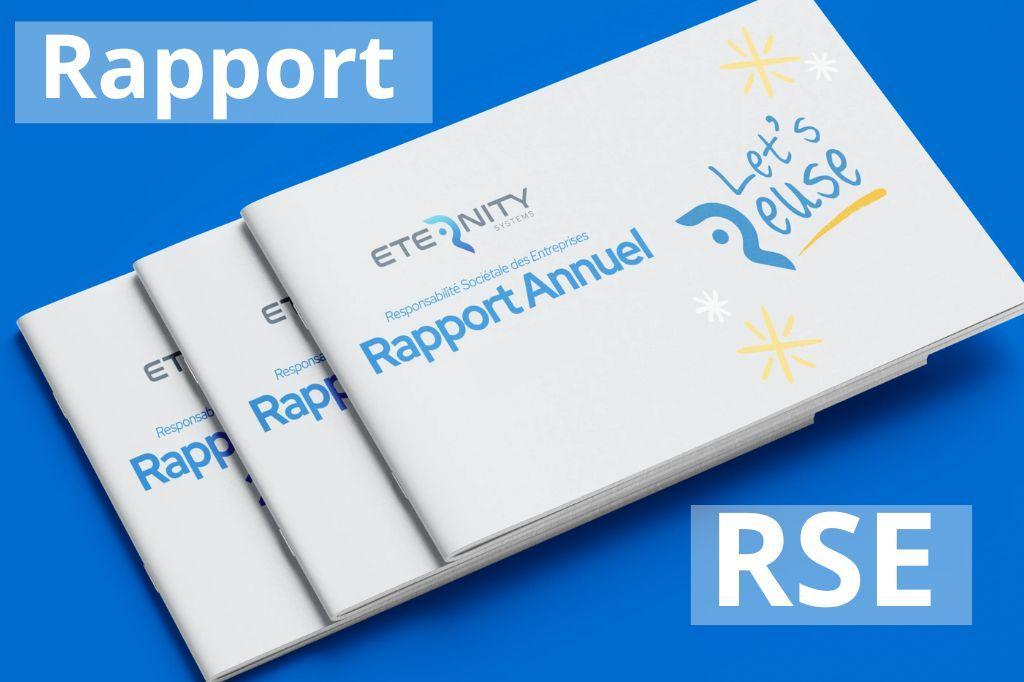
ETERNITY Systems details its CSR strategy in a report structured around 3 pillars: environmental, social and societal. It is through a clear, visual and thematic presentation that the company promotes and concretizes its social responsibility initiatives.
A report aligned with the company's identity
At ETERNITY Systems, the identity has always been based on reuse, sustainability and the circular economy. The CSR report directly translates these values by highlighting actions linked to the core business:
- Reduction of energy consumption
- Optimizing the life cycle of packaging
- Partnerships around reuse
The CSR report must faithfully reflect the company's mission, formalize its actions, while providing concrete evidence of its impact and commitments. The CEO's message illustrates this consistency by recalling the importance of reuse, local roots, sustainability while maintaining a balance with economic performance.

A strategic and operational report
The CSR report plays a triple role:
- Structure the CSR approach at the company level by setting measurable future objectives. For example, the objective of reducing energy consumption at French sites by 30% and obtaining green energy certificates by 2025 are concrete actions to highlight.
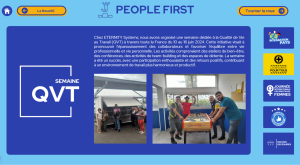
- Mobilize employees and stakeholders around concrete initiatives. For example, the week dedicated to quality of life at work unites teams and promotes links between departments.
- Communicate in a clear, authentic and distinctive way about the company's identity and commitments. For example, through its partnership with Buddie-pack and the publication of a white paper on the reuse of industrial packaging, ETERNITY Systems asserts its position as a leader committed to the circular economy.
A report with results to engage and convince
The CSR report is also a trust tool with all partners because it provides data, monitoring indicators and concrete examples which help to build the trust of stakeholders and convince them of the relevance of the approach.
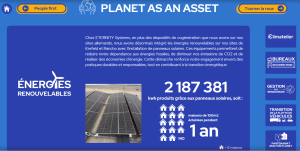
For example, the production of 2 kWh of solar electricity at two industrial sites (Rancho, USA and Krefeld, Germany) is translated into a speaking equivalent: 187 houses of 381 m² powered for one year. This type of numerical indicator makes the impact concrete, facilitates understanding and reinforces the credibility of the report.
Consult the CSR report ofETERNITY Systems by clicking on the button below:
FAQ – Frequently asked questions about the CSR report
Where can I find company CSR reports?
CSR reports are generally available online on the company's websiteFor listed companies or those subject to legal obligations, they can also be consulted on official platforms such as the AMF (Financial Markets Authority) website, the National Register of GHG Emissions or the INPI website.
Who prepares CSR reports?
The drafting of the CSR report is most often prepared by the CSR managerHe works in collaboration with several internal departments such as human resources, quality (QHSE), legal, general management and communication, in order to collect data, structure the content and ensure the overall consistency of the report.
How long does it take to write a CSR report?
Writing a CSR report takes between 1 and 3 months on average depending on company size, CSR experience and data availability.
What standards should be followed for the CSR report?
The most used are ISO 26000 standard (corporate responsibility), the GRI standard (Global Reporting Initiative), the ESRS framework (from the CSRD directive), or the ADEME recommendations for carbon footprints.

Anthony ADAM
Communications and Marketing Manager at ETERNITY Systems, Anthony designs strategies and content to promote more sustainable consumption. He is a committed agent of change who combines creativity, rigor, and action to strengthen the visibility and impact of projects related to reuse and the circular economy.
These articles might also interest you



GHG Protocol: How to calculate and manage GHG emissions?
CSRD Directive: Definition, challenges and current status 2025
A project to reuse packaging?
Our teams support you from diagnosis to industrial washing, in Europe and North America.
Contact us