
Circular packaging solutions: what options are available for businesses?
A circular packaging solution is a method of designing, using, and managing packaging that aims to maintain its value for as long as possible, preventing it from becoming waste. It encompasses four main categories: eco-design, the incorporation of recycled materials, recyclability, and reuse. In 2023, […]

Article summary
- Circular packaging solutions in summary
- What is a circular packaging solution?
- What are the different circular packaging solutions?
- Ecodesign
- The incorporation of recycled material
- Recyclability and recycling
- Reuse: the most virtuous circular packaging solution
- What are the advantages of circular packaging?
- Which packaging and sectors are affected by a circular solution?
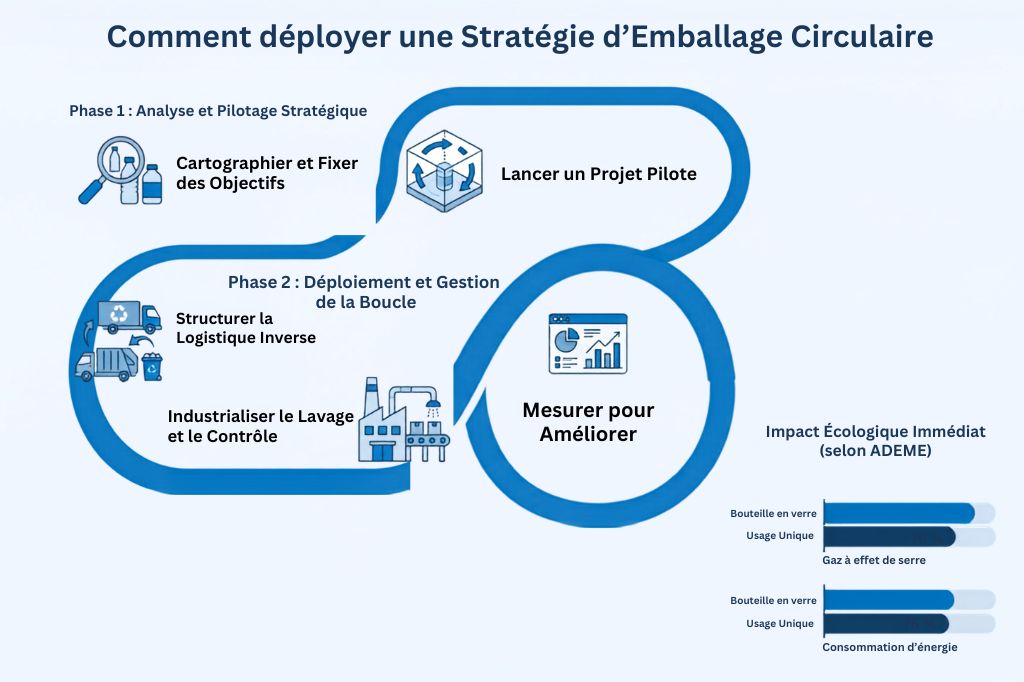
- How to deploy a circular packaging solution in your company?
- 1. Map the packaging flows
- 2. Define measurable objectives
- 3. Start with a pilot project
- 4. Organize the reuse loop
- 5. Working with suppliers and logistics partners
- 6. Rely on an industrial washing specialist
- 7. Measure the results and improve the system
- What does the regulation say about circular packaging?
- The AGEC law
- The European PPWR regulation
- The Extended Producer Responsibility (EPR) scheme for professional packaging
- ETERNITY Systems, industrial partner for your circular packaging solutions
A circular packaging solution is a method of designing, using and managing packaging that aims to maintain its value for as long as possible, in order to prevent it from becoming waste. It encompasses four main categories: eco-design, incorporation of recycled material, recyclability and reuse.
In 2023, the European Union produced 79,7 million tonnes of packaging waste, or 177,8 kg per capita. according to EurostatWith 30 years of expertise in industrial washing and circular logistics, ETERNITY Systems presents circular packaging solutions, their differences, their regulatory framework and how to deploy them in your company.
Circular packaging solutions in summary
- A circular packaging solution maintains the value of the packaging. by prioritizing, in order, reduction at source, reuse, then recycling.
- Reuse is the most virtuous solution. : the packaging retains its status as a product and avoids any transformation of the material.
- Reusing a glass bottle generates up to 79% less greenhouse gas emissions. and consumes 76% less energy than a single-use bottle, according to ADEME.
- Reuse only works with an industrial infrastructure : collection, washing, quality control, repair and traceability of packaging.
- The PPWR regulations and the AGEC law impose quantified targets. reduction and reuse, with 40% of transport packaging to be reused by 2030.
What is a circular packaging solution?
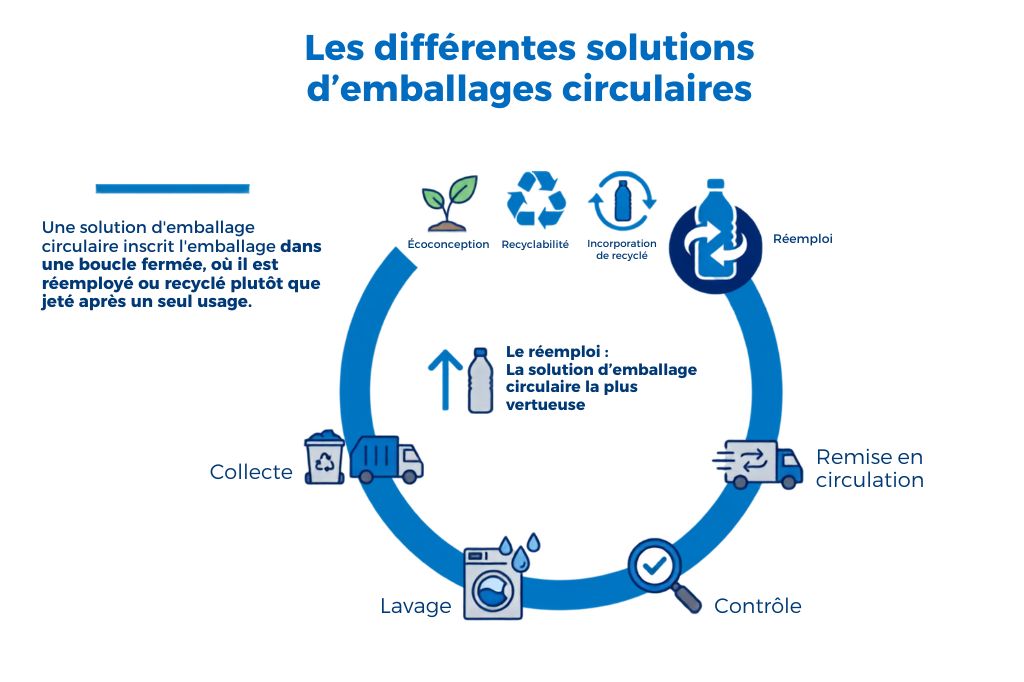
A circular packaging solution places the packaging in a closed loop, where it is reused or recycled rather than thrown away after a single use. It opposes the linear model of "extract, produce, consume, discard".
This approach stems directly from the principles ofcircular economywhich aims to preserve natural resources by extending the product lifecycle. Its objective is to minimize waste and optimize resource use by keeping materials in use for as long as possible, at all stages of their life cycle: design, production, distribution, use and end of life.
A circular packaging solution allows for significantly reduce the environmental footprint global in particular by reducing greenhouse gas emissions, saving energy and water, and limiting the exploitation of natural resources.
What are the different circular packaging solutions?
Circular packaging solutions fall into four categories:
- Ecodesign,
- The incorporation of recycled material,
- Recyclability and
- Reuse.
Ecodesign
Eco-design involves integrating environmental criteria from the initial packaging design stage.in order to reduce its impact over its entire life cycle. This is the principle of "just the right packaging," which is to use only the amount of material strictly necessary to protect the product.
Specifically, it aims to:
- Reducing the weight and volume of packaging: manufacturers are significantly lightening their containers. For example, the standard champagne bottle has gone from 900 g to 835 g.
- Eliminating excess packaging: Some brands are removing labels from their bottles or replace overwrap sleeves with direct printing on the container.
- Facilitating end-of-life sorting.
The incorporation of recycled material
The incorporation of recycled material involves manufacturing packaging from recycled materials rather than virgin materials. Because this reduces dependence on fossil resources and provides an outlet for collected materials.
However, this solution has a technical limitation because for some materials like plastic, the material degrades with each recycling cycle, which restricts the number of possible re-incorporations.
Recyclability and recycling
Recycling is a recovery operation where packaging that has become waste is destroyed to extract the material, which is then transformed into a new object. Recyclability, on the other hand, refers to the ability of packaging to be effectively collected, sorted and recycled.
Recycling is essential, but it doesn't close the loop on its own. In 2023, 67,5% of packaging was recycled in the EU (Eurostat), and yet the volume of waste per capita has increased. Recycling consumes energy, loses some material with each pass, and does not reduce the number of packages put on the market.
Reuse: the most virtuous circular packaging solution
Reuse consists of using the same packaging multiple times for the same purpose, without it ever becoming waste. This is the only solution where reusable packaging retains its product status throughout its entire lifecycle. It eliminates waste at the source, whereas other solutions merely optimize packaging destined for disposal. It represents the most advanced form ofcircular economy applied to packaging.
A crate, bin, or bottle designed for reuse can complete dozens, or even hundreds, of cycles. Reuse is thus distinct from recycling, which destroys the material, and from simple repurposing, which applies to an object that has already become waste. According to a study by ADEMEA reused glass bottle generates up to 79% less greenhouse gas and consumes 76% less energy than a single-use bottle over its entire life cycle.
Manufacturers are now designing increasingly robust packaging to maximize these cycles: some plastic bottles can now complete up to 25 rotations in setpoint circuits, and glass bottles are reused on average 19 times (circulating for more than 6 years) before finally being recycled.
What are the advantages of circular packaging?
A circular packaging solution provides four advantages: environmental, economic, regulatory and image-related.
- Environmental advantage : by extending the lifespan of packaging, circularity reduces the consumption of raw materials, greenhouse gas emissions and waste production, directly at the source. Circular packaging also responds to the growing demand for sustainable products and allows consumers to make more responsible choices.
- Economic advantage Circular packaging limits the purchase of new packaging, reduces waste treatment costs and protects the company from raw material price volatility.
- Regulatory advantage : Compliance with EU regulations and anticipating the obligations of the AGEC law, the PPWR and the new EPR sector avoids rushed and costly compliance at the time of deadlines.
- Image advantage and CSR : a circular solution meets the growing expectations of customers and consumers, and concretely fuels the extra-financial reportingIt is also a way to differentiate oneself and position oneself as a leader in sustainability and strengthen brand reputation.
Which packaging and sectors are affected by a circular solution?
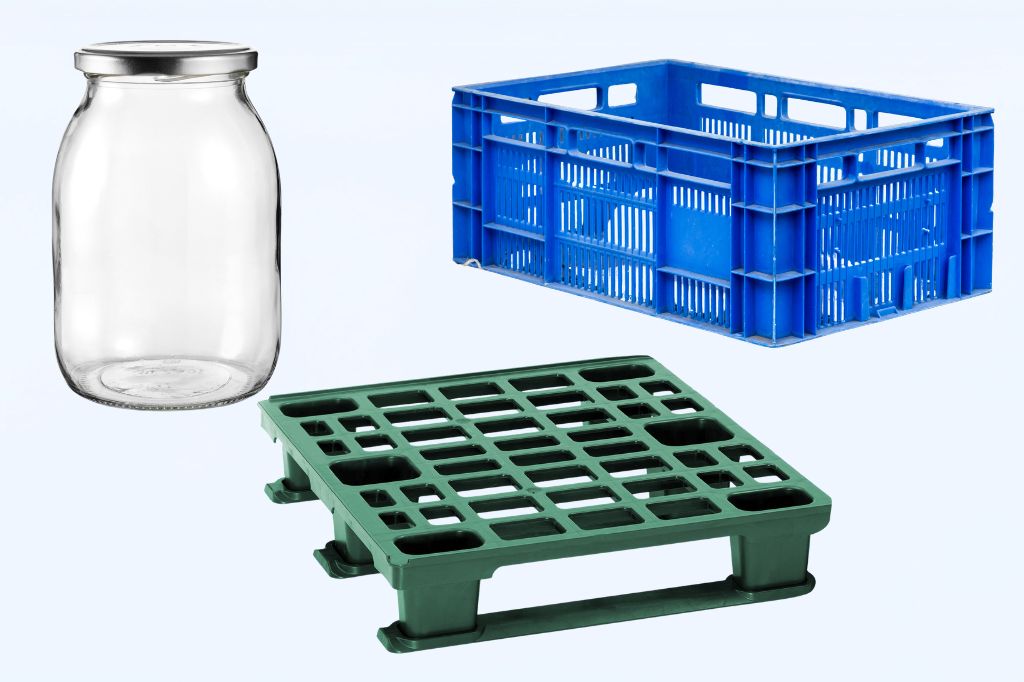
The three levels primary, secondary and tertiary packagingAll of these can be part of a circular solution. However, secondary and tertiary packaging are the most suitable for reuse because these containers circulate regularly between the same professionals, making collection, washing, and recirculation easier to organize and profitable.
Reusing primary packaging is more restrictive because it is in direct contact with the product, requires more rigorous washing and must comply with strict hygiene standards.
Secondary and tertiary packaging is generally robust, standardized, and designed for repeated use. After use, it can be collected, cleaned, inspected, and then put back into circulation. A plastic crate or pallet can thus be reused hundreds of times.
Circular packaging solutions therefore primarily concern:
- Agribusiness : crates, bins and containers for fruit, vegetables, meat, fish or bakery products.
- The drinks : returnable glass bottles, a historical reuse model that PPWR is reviving.Industrial logistics and supply chain pallets, bins, buckets and silos circulating between sites and suppliers.
- Large retailers and e-commerce : reusable transport packaging and return systems.
- Catering services : gastronorm containers and reusable tableware, now mandatory in many cases.
How to deploy a circular packaging solution in your company?
Deploying a circular packaging solution is not just about choosing a reusable container. It also requires organizing the entire process of collecting, cleaning, inspecting, and putting it back into circulation.
Without a collection and washing system, packaging designed for reuse risks ultimately being thrown away after a single use.
1. Map the packaging flows
The first step is to conduct an audit of the packaging used by the company. This involves identifying:
- the different types of containers;
- the volumes consumed;
- their frequency of use;
- their purchase and processing costs;
- their destination after use;
- losses and the main sources of waste.
This analysis helps identify the waste streams where reuse would be simplest and most relevant. It also helps assess potential savings and the reduction of indirect greenhouse gas emissions, particularly those falling under Scope 3.
2. Define measurable objectives
The company must then set specific objectives, for example:
- Reduce the consumption of single-use packaging by 30%;
- Achieve a return rate of 90%;
- Reuse each container a minimum number of times;
- Reduce the volume of packaging waste produced each year.
These objectives must be adapted to the company's operational realities. They can then be integrated into its CSR policy and his extra-financial reporting
3. Start with a pilot project
It is best to test the solution on a limited scale before rolling it out more broadly. The pilot could involve a type of packaging, a product range, a supplier, a site, or a geographical area.
This phase allows us to measure concretely:
- the return rate of packaging;
- the number of possible rotations;
- the costs of collection, transport and washing;
- losses or damage;
- health restrictions;
- the impact on team organization.
The test results then allow the device to be adjusted before a gradual, larger-scale deployment.
4. Organize the reuse loop
A circular solution must consider each stage of the packaging process:
- use by the client or the recipient site;
- collection of empty containers;
- return transport, also called reverse logistics;
- packaging sorting;
- industrial washing;
- checking the cleanliness and condition of the containers;
- repair or removal of damaged packaging;
- returned to circulation.
Each stakeholder must know their role, the deadlines to be met, and the storage conditions for empty packaging. The system must also minimize unnecessary journeys so that the environmental benefits of reuse are not negated by overly complex logistics.
5. Working with suppliers and logistics partners
Suppliers should be involved in the project from the outset. They can suggest more sustainable packaging, provide information on its composition, and help the company implement take-back or recycling solutions at the end of its life.
The company must also request reliable data on:
- the origin of the materials;
- the estimated lifespan of the containers;
- their recyclability;
- their environmental footprint;
- the conditions for repair or replacement.
This collaboration helps to secure supply and build a coherent reuse loop between suppliers, production sites, customers and service providers.
6. Rely on an industrial washing specialist
Washing is a key step, especially for packaging that comes into contact with food, sensitive products, or industrial materials.
A specialist partner like ETERNITY Systems It can handle the washing, inspection, sorting, repair, and sometimes the logistics management of packaging. It can also help the company size the solution according to volumes, rotation frequencies, and the expected level of cleanliness.
7. Measure the results and improve the system
Once the loop is in place, its effectiveness must be monitored regularly using indicators such as:
- the return rate;
- the average number of reuses per package;
- the rate of loss or breakage;
- the cost per rotation;
- the amount of waste avoided;
- water and energy consumption related to washing;
- greenhouse gas emissions avoided.
This data allows us to compare results with set objectives and identify potential improvements. A circular packaging solution must evolve gradually to become simpler, more reliable, and more cost-effective.
What does the regulation say about circular packaging?
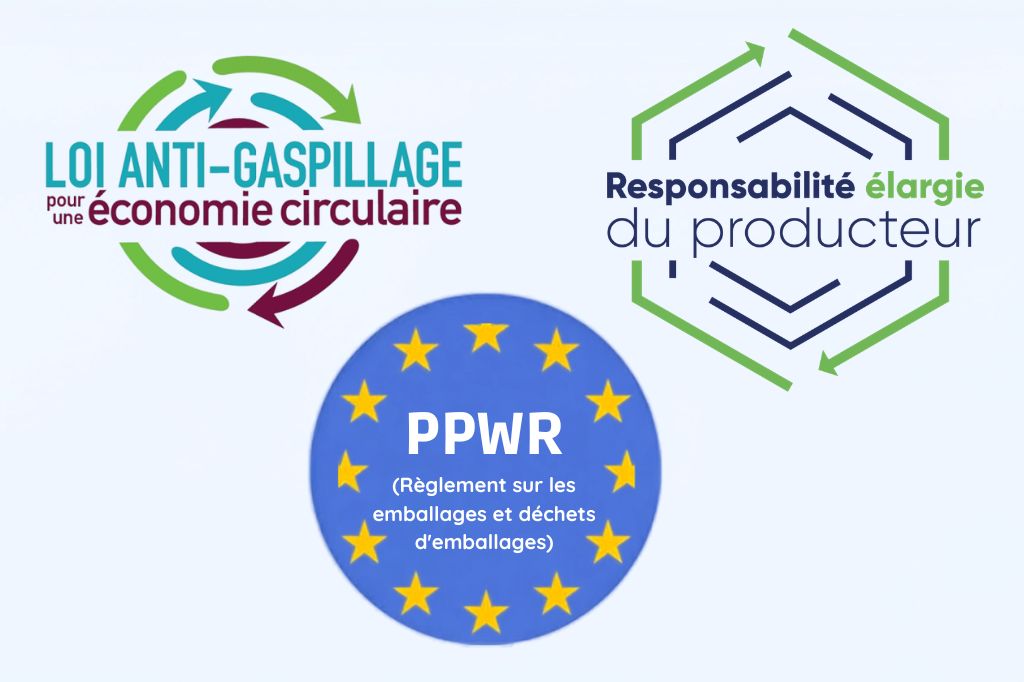
Regulations impose quantified targets for reduction, reuse and recyclability on companies that place packaging on the market. Three texts structure this framework: the AGEC law, the PPWR regulation and the new EPR sector for professional packaging.
The AGEC law
La Anti-Waste Law for a Circular Economy (AGEC) sets reuse thresholds for producers: 5% of packaging reused in 2023 and 10% in 2027. Since 2024, any company placing at least 10,000 units of packaged products on the market must declare its reuse rate to ADEME every year.
The European PPWR regulation
Le PPWR regulations (EU 2025/40) applies from 12 August 2026 in all Member States, without national transposition. It sets three main objectives:
- Reducing packaging waste : −5% in 2030, −10% in 2035 and −15% in 2040, compared to 2018.
- Reuse of transport packaging (pallets, crates, bins): at least 40% in 2030, then 70% in 2040.
- Recyclability : all packaging placed on the market must be recyclable by 2030.
The Extended Producer Responsibility (EPR) scheme for professional packaging
A new extended producer responsibility (EPR) scheme dedicated to professional packaging was created by decree no. 2025-1081 of November 17, 2025, for an operational launch on July 1, 2026. It aims to finance the collection and accelerate the reuse of secondary and tertiary packaging, which until now has been poorly covered by regulations.
ETERNITY Systems, industrial partner for your circular packaging solutions
ETERNITY Systems is the industrial partner that makes your circular packaging solutions work, from collection to recirculation. For over 30 years, we have been supporting companies in the agri-food, logistics, mass retail and catering sectors.
We have dealt Over 7 billion reusable packages since 1994, across 17 sites in 6 countries. Our strength lies in managing the entire reuse cycle:
- Industrial washing crates, bins, buckets, glass bottles, gastronorm containers and pallets, according to protocols adapted to each sector. Our closed-loop systems reuse more than 70% of the water consumed, and one liter of wash water can be reused up to 300 times.
- Dedicated logistics : collection of used packaging, sorting, return transport and rerouting to your sites, including internationally.
- Packaging repair damaged to prolong their lifespan and delay their exit from the loop.
- Digital traceability of each batch, from its departure from the customer to its re-entry into circulation, is essential for the CSR reporting.
- Automated glass sorting : since January 2026, the acquisition of the German player CLS complements our know-how with the automated sorting of glass bottles and crates for the beverage industry.
- Program Re-uz for ETERNITY : a solution dedicated to institutional catering for washing gastronorm containers and reusable tableware.
What sets us apart is this ability to operate the entire loop. Are you looking to assess the potential of a circular packaging solution in your operations? Contact us ETERNITY Systems for an audit of your packaging flows and an estimate of your potential savings.

Anthony ADAM
Communications and Marketing Manager at ETERNITY Systems, Anthony designs strategies and content to promote more sustainable consumption. He is a committed agent of change who combines creativity, rigor, and action to strengthen the visibility and impact of projects related to reuse and the circular economy.
These articles might also interest you

Supermarket packaging: how does reuse work?
Sustainable packaging: the complete guide
A project to reuse packaging?
Our teams support you from diagnosis to industrial washing, in Europe and North America.
Contact us