
The pillars of CSR: understanding and implementing a responsible business strategy
The pillars of CSR, numbering 3 or 7 depending on the approach, form the basis for building a responsible and sustainable approach for companies wishing to integrate a Corporate Social Responsibility strategy and address climate, social, and ethical challenges, in order to have an impact […]


The pillars of CSR, numbering 3 or 7 depending on the approach, are the basis for building a responsible and sustainable approach for companies wishing to integrate a Corporate Social Responsibility strategy and address climate, social and ethical challenges, in order to have a positive impact while ensuring economic sustainability.
But what exactly are these pillars of Corporate Social Responsibility? Are there 3 or 7? How do we use them? ETERNITY Systems It explains everything about the pillars of CSR – definition, advantages, examples – to help you understand how to integrate them into a company's CSR strategy.

The pillars of CSR in summary
The pillars of CSR are the main areas in which a company can act to have a positive impact on society and the environment, while maintaining good economic stability. Depending on the approach, there are 3 or 7 pillars of CSR:
- The 3 fundamental pillars of CSR environmental, social and economic factors, which form the original basis of a CSR approach.
- The 7 pillars of the international standard ISO 26000 which goes further and also integrates governance, human rights, fair business practices, customer relations and local engagement.
Whether it concerns the environment, social issues, the economy, or governance, each pillar helps to structure CSR actions to give meaning to the sustainable and responsible commitments that companies make.
What is CSR?
Corporate Social Responsibility (CSR) This encompasses all voluntary actions implemented by companies to integrate social, environmental, and economic considerations into their operations. Framed since 2010 by the ISO 26000 standard, it also incorporates principles of transparency and ethics. Now essential, these actions concern all companies, regardless of their size or sector, and represent a lever for building trust and commitment with customers, partners, and employees who expect concrete actions.
What are the 3 pillars of CSR?
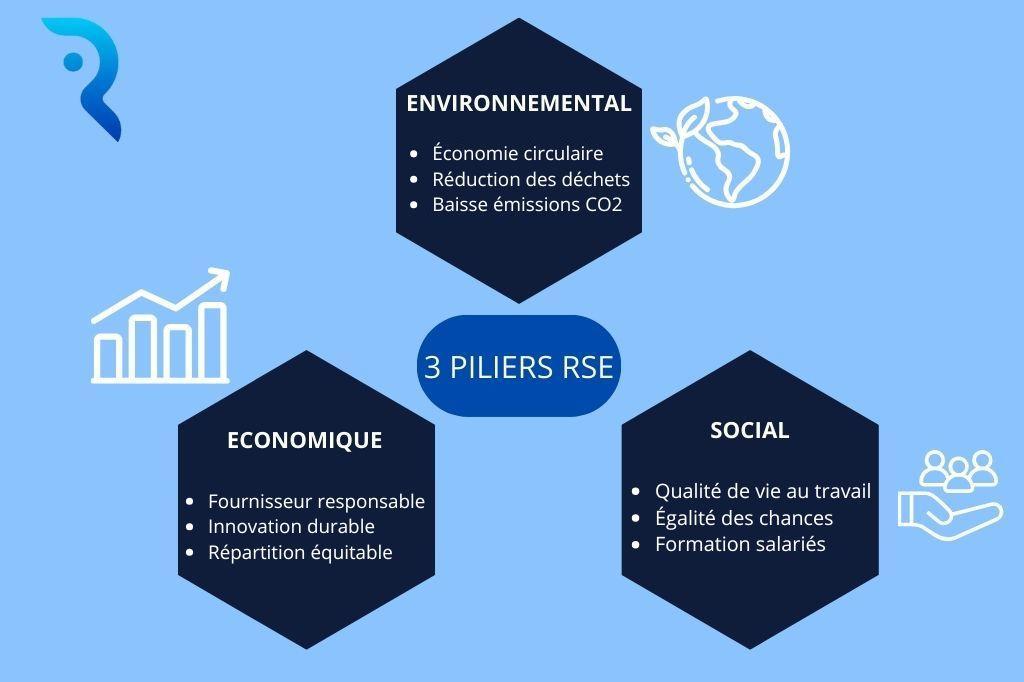
CSR, in the eyes of the European Commission, is traditionally based on 3 interdependent pillars :
- An economic pillar,
- A social pillar,
- An ecological pillar.
Understanding these 3 CSR pillars means being able to adopt a solid and consistent strategy that meets today's expectations.
The environmental CSR pillar
The environmental pillar of CSR covers all actions aimed at reducing a company's ecological impact. For example:
- Waste reduction : by optimizing production processes, eliminating unnecessary packaging or developing internal sorting and recycling.
- Reduction of CO2 emissions and GHG balance : by rethinking work journeys, improving the energy efficiency of buildings or investing in renewable energies.
- Choice of eco-friendly products: whether it is raw materials, supplies or cleaning products, giving preference to those that are certified (such as Ecolabel).
- Implementation of circular economy practices such as reusing materials, repairing equipment, sharing resources, or recycling waste. These practices are part of a logic of reuse and help to limit the extraction of new resources.
- Employee awareness: train and involve teams in everyday eco-friendly practices (paper reduction, waste sorting, digital sobriety), to make the ecological transition a shared approach at all levels of the company.
This CSR pillar encourages companies to concretely integrate these environmental concerns. in their business activities, to reduce their negative impact on the environment. Indeed, according to ADEME, 50% of GHG emissions in France come from business activities.
Beyond the increasing regulatory pressure (Grenelle law, AGEC law, climate law, etc.), limiting its environmental impact also means responding to the growing expectations of customers, partners and employees.
The economic CSR pillar
A company cannot be socially and environmentally virtuous if it is not economically stable. In other words, Economic viability forms the basis of a sustainable CSR approachHow to do it? It's about generating long-term value while respecting resources, people, and the local economic fabric.
In practice, this translates into reasoned, responsible, ethical, and transparent actions and growth choices that will stimulate productivity:
- Choosing responsible suppliers: Prioritize local partners committed to ethical, sustainable, and social practices. This strengthens local ecosystems, reduces risks associated with supply chains, and ensures better traceability.
- To have a fair distribution of the value created : better sharing of benefits between the different stakeholders (employees, partners, shareholders, territories) helps to strengthen collective commitment to the company project.
- Investing in sustainable innovation : to seek new ideas that allow us to both better respect the environment, improve working conditions and increase efficiency. This makes it possible to optimize costs, improve transparency, and reduce the ecological impact of operations (less travel, better allocation of resources).
- Promote der Kreislaufwirtschaft, as we do at ETERNITYwhere we have a model designed to extend the lifespan of products, limit waste and valorize waste.
An economically responsible company is more resilient to crises, attracts quality customers and partners, and builds a brand forteThe various actions taken to create a more responsible company should not be seen as an obstacle. On the contrary, they will allow the company to create value with more productive teams, better resource management, and the reduction of certain risks such as turnover or supplier disputes.
The social CSR pillar
The social pillar of CSR encompasses all actions aimed at improving working conditions, quality of life and professional development of employees. The goal: to place people at the heart of how the company operates.This approach is not just about goodwill, but a way to engage employees so that they are more productive.
In France, according to a Harris Interactive study, nearly a third of people consider a company's CSR commitment a priority criterion when choosing a brand or employer. This shows that employees are looking for meaning, recognition, a healthy work environment, and career prospects. This translates concretely into actions such as:
- Inclusion and equal opportunities : putting in place, for example, non-discriminatory recruitment policies, promoting diversity of profiles in teams or guaranteeing the same opportunities for advancement to all, regardless of age, gender, origin.
- Improvement of working conditions This concerns physical safety (equipment, work environment), but also psychological well-being. It involves limiting physical strain, avoiding unbalanced working hours, and offering flexibility or teleworking options.
- Quality of working life (QWL) : it is about promoting a balance between professional and personal life, establishing a climate of trust, encouraging dialogue between teams and management.
- Training and skills development It is very beneficial to allow each employee to progress, develop their skills and envision their future. This strengthens motivation and reduces turnover.
What are the 7 pillars of CSR?
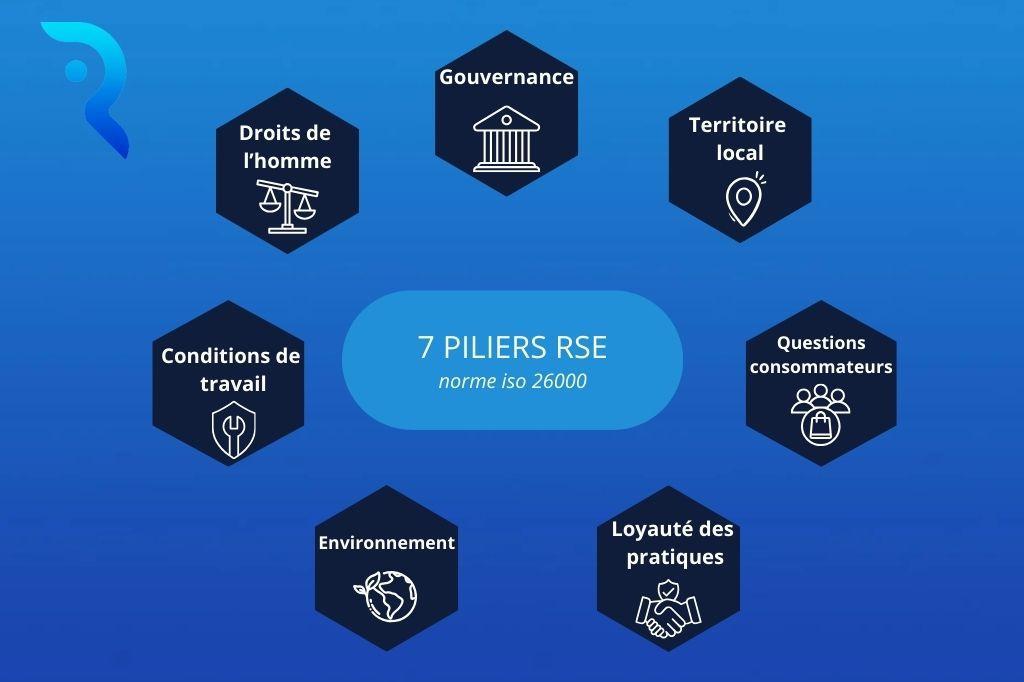
In addition to the 3 classic CSR pillars, the 2010 ISO 26000 standard governing CSR goes further and proposes a strategy based around 7 pillars :
- Organizational governance,
- Human rights,
- Working relationships and conditions,
- Environment,
- Loyalty in practices,
- Consumer-related questions,
- Territory and local interest.
These 7 modern CSR pillars form the international reference framework, aiming to cover an even broader scope of CSR by integrating dimensions such as ethics, transparency, and human rights:
- The organization's governance: concerned The way in which the company makes decisions, sets objectives, evaluates results, and communicates with various stakeholders. It's about ensuring that decisions are made clearly, responsibly, and with the common good in mind, not just short-term profitability.
- Human rights: This CSR pillar concerns respect for the fundamental rights of individuals within the company. The objective is to guarantee that each employee is treated with respect, fairness, and dignity, and to combat all forms of discrimination in order to ensure fair working conditions for all.
- Working relationships and conditions: This encompasses everything related to the health, safety, well-being, and development of employees in their work environment. It's about creating a healthy, motivating, and respectful setting where everyone can thrive and feel heard.
- The environment : This pillar holds a central place in CSR, also being one of the three traditional pillars. The objective remains the same: to integrate the environment into all of the company's decisions, in order to reduce its ecological footprint and actively contribute to the ecological transition.
- The fairness of practices: The way the company conducts its business, ensuring that its practices are honest, fair, and compliant with regulations. This includes combating corruption, promoting fair competition, and maintaining transparency in business relationships. The goal is to act ethically and responsibly in all professional relationships (customers, suppliers, partners, institutions, etc.).
- Consumer issues This CSR pillar focuses on the relationship between the company and its customers. It involves offering quality services, keeping promises, and inspiring trust. It also means ensuring that customers are well-informed, listened to, and protected. For example, this means providing clear information about services, guaranteeing on-time delivery, implementing responsive after-sales service, and protecting consumer data.
- Territory and local interest: This concerns the role of the company in society, beyond its economic activity. It means that the company must act as an engaged member of the community, contributing to local development and supporting those in need. For example, this can involve supporting local suppliers, backing a local association, or participating in community events.
How to integrate the pillars of CSR into a business strategy?
Articulating the pillars of CSR within a corporate strategy involves aligning social, environmental, and economic issues with the concrete realities of the organization. ETERNITY SystemsIt starts with a key question: what are the priority issues for our business, our teams and our territory?
Based on this reflection, we defined a clear method for linking our values, our business activities, and the expectations of our stakeholders to the three traditional pillars of CSR. In concrete terms, this is achieved through:
- An initial diagnosis The company analyzed its industrial processes for washing reusable packaging to identify strengths and areas for improvement, particularly regarding water and energy consumption. This analysis, conducted according to a QHSE approach (Quality, Hygiene, Safety, Environment), has shown that, thanks to an internal purification process, 1 liter of water is reused up to 300 times, thus achieving significant savings.
- Prioritizing the issues : ETERNITY Systems identified priority issues by combining the expectations of its stakeholders with its strategic objectives. This approach led to the emergence of three major areas: valuing and empowering employees, controlling environmental impact, and strengthening local engagement.
- Developing an action plan : ETERNITY Systems deployed a concrete action plan around its CSR priorities: training for team safety, a traffic plan to reduce risks, energy optimization and waste reduction in the factory, as well as actions in favor of diversity, with an increase in female recruitment in production.
- Indicator monitoring : ETERNITY Systems has defined key indicators to track the effectiveness of its CSR actions. For example, the company measures the percentage of water saved through its internal purification process and the number of certifications obtained for its organization, reflecting its commitment to quality and the environment.
- Transparent communication The results are shared in an annual CSR report available online, which details commitments, concrete achievements, and next steps. This transparency helps build trust with clients, teams, and public and private partners. In line with this approach, ETERNITY Systems also participates in 2025 Bulk and Reuse Fair.
You now understand the 3 fundamental pillars and the 7 modern pillars of CSR and their strategic role in developing a responsible business. By integrating this approach into your organization, you are taking concrete steps towards a more ethical, sustainable, and successful future, while meeting the expectations of your employees, customers, and partners.
At ETERNITY Systems, thanks to our industrial washing solutions, reuse, repair, storage and transport of reusable packaging, we support companies towards sustainable performance, aligned with the requirements of international standards.
Join us in a responsible approach, and make Corporate Social Responsibility a true lever for transformation.

Anthony ADAM
Communications and Marketing Manager at ETERNITY Systems, Anthony designs strategies and content to promote more sustainable consumption. He is a committed agent of change who combines creativity, rigor, and action to strengthen the visibility and impact of projects related to reuse and the circular economy.
These articles might also interest you


GHG Protocol: How to calculate and manage GHG emissions?
CSRD Directive: Definition, challenges and current status 2025

A project to reuse packaging?
Our teams support you from diagnosis to industrial washing, in Europe and North America.
Contact us